

Copyediting: What Authors Should Expect
Copyediting is the stage of the publishing process that makes a manuscript consistent, correct, and clear before it is designed and proofread. A copy editor (sometimes styled as a professional copyeditor) reviews grammar, punctuation, spelling, and style so that readers are not stopped by mistakes, inconsistencies, or formatting issues. Copyediting, also written as copy editing, is not the same as rewriting a book, and it is not the last look at a printed page.
This article explains the tasks involved in professional copyediting, the difference between copyediting vs proofreading, and how this editing phase sits next to developmental editing and line editing. It is general guidance for writers and indie authors, not a promise that any manuscript will be error free, and not legal advice about copyright or permissions. For earlier structural work, see our manuscript editing services guide. For the pass that follows typesetting, see book proofreading services. To talk through an edit, call (888) 209-4055 or contact us.
What Copyediting and Copy Editing Cover in the Editing Phase
Copyediting and copy editing are the same kind of work. Usage varies by publishing house, region, and job title, but the point of the edit is the same: a close review of the language and the mechanical details of the document so the writing is ready for design. The Chartered Institute of Editing and Proofreading describes copyediting as work that makes the text clear, consistent, and correct, and that prepares it for the next stage of production, in its overview of what copyediting is.
A professional editor working at this level typically looks at:
- Incorrect grammar, punctuation, and spelling mistakes, including typos that self editing often misses.
- Word choice, tone, and clarity at the sentence level, including a note when a recast of a sentence would help readers.
- Internal consistency: names, dates, numbers, hyphenation, capitalization, and how terms are spelled from chapter to chapter.
- Style rules drawn from agreed style guides, plus a style sheet the editor created for that manuscript.
- Formatting of paragraphs, lists, chapter titles, quotation marks, ellipses, and typographic details such as em dashes.
- Page-level mechanics that can be checked in a manuscript file, such as page numbers, heading hierarchy, and obvious page breaks in the source document.
- Flags for possible legal issues, such as a missing credit, a quotation that may need permission, or a copyright page that still needs review. Those flags are not a legal opinion.
Copy editing checks that spelling, punctuation, and style decisions stay aligned across the manuscript. It also aims for consistency in how titles, numbers, and terms appear. That is a description of the work, not a guarantee that no error can remain. Accuracy still depends on the author's answers to queries and on a later proofread of the designed pages.
Editing of this kind should preserve the author's voice. The copy editor is not trying to make every writer sound the same. The goal is a professional, readable text that still sounds like the person who wrote it.
How a Copy Editor Works Through an Editing Process
The editing process usually starts with a sample or a scope conversation, then a full pass through the manuscript. Many editors work in a Word file with tracked changes, though some teams annotate a PDF. The tool matters less than a clear record of what was changed and why.
A careful copy editor will often:
- Confirm the style guide (for example, The Chicago Manual of Style or AP style) and any house style the author or publisher already uses.
- Read for sense as well as mechanics, so a paragraph that is grammatically fine but confusing can be queried.
- Keep a style sheet: a running table of decisions (spellings, hyphenation, treatment of numbers, unusual proper nouns) so later chapters match earlier ones.
- Query rather than guess when meaning is unclear, a fact cannot be checked from the text, or a change would affect the author's argument.
- Return a marked manuscript plus a short note on patterns, so the author can review changes in an organized way.
Self editing is still worth doing first. Writers who clean up obvious typos, repeat words, and loose structure give a professional copyeditor more time for the issues that are harder to see from inside the draft. A short test version of a chapter can also help the author and editor agree on tone before the full manuscript is in motion.
If two people will touch the file, it is often wiser to use a separate copy editor from the person who did the developmental work. A fresh reader is more likely to catch inconsistencies the first editor no longer sees.
Developmental Editing, Line Editing, and Copyediting: Different Stages
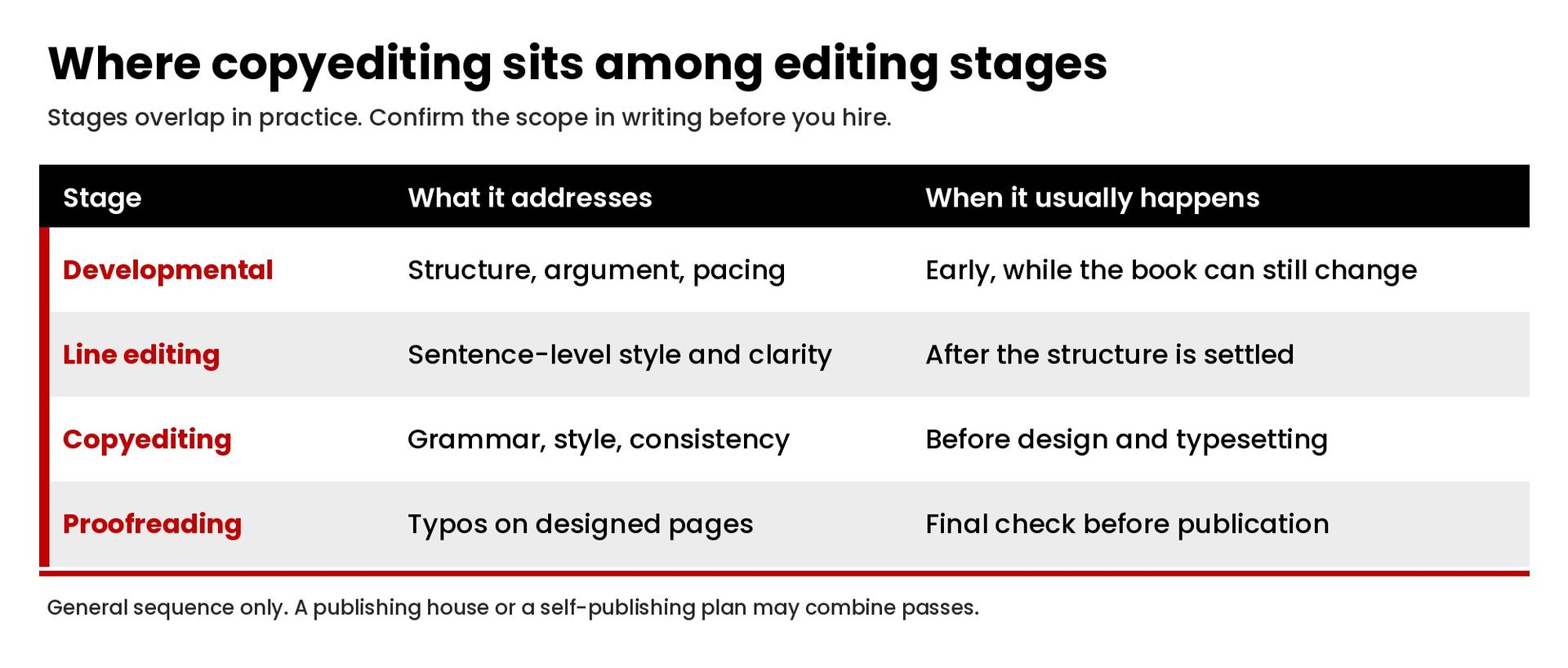
Authors often hear several job titles at once. The stages overlap in practice, but they are aimed at different problems.
Developmental Editing and Big Picture Issues
Developmental editing looks at the big picture issues: argument, structure, pacing, chapter order, and whether the manuscript does what it set out to do. Substantive editing is a closely related term some publishers use for deep work on content and organization. Those passes belong earlier. Our developmental editing services page covers that stage. Copyediting is a poor substitute for a book that still has structural gaps.
Line Editing at the Sentence Level
Line editing works at the sentence level: rhythm, word choice, repetition, and how a paragraph lands. It is more stylistic than a mechanical copyedit and less structural than a developmental pass. For that distinction, see our guide to line editing services. Some projects combine line editing and copyediting in one agreement. Authors should ask, in writing, which tasks are included, so the sentence-level work is not assumed.
Copyediting as a Later Editing Phase
In a traditional publishing process, copyediting usually follows developmental (and sometimes line) work and precedes design and proofreading. In self publishing, the same order still helps. Indie authors who jump straight from a first draft to a proofreader often discover, late, that style and consistency problems are still in the file. Copyediting is not always the final step of writing, but it is a late editing phase, after the big picture is settled.
Copyediting vs Proofreading: The Final Check Before Publication
Proofreading is a different job. A proofreader does a final check of typeset or designed pages: leftover typos, dropped words, bad hyphenation, incorrect running heads, and formatting issues that appeared when the file was laid out. The Chartered Institute of Editing and Proofreading, in the same overview cited above, treats proofreading as a later quality-control pass, not a second copyedit.
In short:
- Copyediting happens in the manuscript, before design, and addresses grammar, style, consistency, and clarity.
- Proofreading happens on a test version of the designed pages and looks for errors introduced or missed before the book is printed.
Both matter. Copyediting cannot replace a proofread of the designed pages, and a proofreader should not be asked to recast sentences or rebuild a style system. If you need a map of the broader service offer, start with book editing services.
Style Guides, the Copyright Page, and Other Details Authors Should Expect
Most professional copyediting is anchored in style guides. U.S. book work often uses The Chicago Manual of Style. News and some marketing work may use AP style. Academic projects may use another guide. The editor's job is to apply the chosen guide, record exceptions on the style sheet, and query anything that would change meaning.
Authors should also expect attention to front-matter details that can be checked in the file, including chapter titles, the table of contents against those titles, and the copyright page. This article does not invent legal wording for a copyright notice. If a statement on that page needs a legal review, that review belongs with qualified counsel, not with the copyedit alone.
Fact-checking varies by project. Some copyeditors verify names, dates, and simple claims that can be checked quickly. Others mark a passage for the author to confirm. Do not assume a copyedit includes a full legal or academic fact audit unless that scope is written down.
What Self Publishing Authors and a Publishing House Both Need
A publishing house typically builds copyediting into the production path: the manuscript is accepted, edited in stages, designed, and proofread. Self publishing and indie authors have to assemble that path themselves. The work does not change because the imprint is the author's own. The risk of skipping it is the same: readers notice spelling mistakes, inconsistent hyphenation, and unclear sentences, and those problems are harder to repair after publication.
Whatever the path, ask a prospective editor for a sample, a description of the tasks involved, the style guide they will use, and how queries will be handled. Rates and timelines vary; this article does not invent them. Confirm both before you hire.
Frequently Asked Questions
Is copyediting the same as proofreading?
No. Copyediting is a manuscript edit for grammar, style, and consistency. Proofreading is the final check of designed pages before publication.
Can I do only self editing?
Self editing is a useful first pass, but most writers benefit from a separate copy editor. Familiarity with your own sentences makes some errors hard to see.
Will copyediting fix structure?
No. Big picture issues belong in developmental editing. Copyediting can recast sentences and fix consistency, but it should not be asked to replot a book.
Plan the Copyedit Before You Go to Design
Copyediting is the point in the publishing process where a manuscript is made consistent and clear enough to design. Done in the right order, after developmental or line work when those are needed, and before proofreading, it gives readers a cleaner page and gives the author a professional record of the decisions behind that page.
To discuss a copyedit with Masterly Publishing, contact us or call (888) 209-4055.