

Manuscript Editing Services: What Authors Should Fix Before Copy Editing and Proofreading
Finishing a manuscript is a major point in the writing process, but a finished draft is not always ready for final polishing.
The story may have sections that move too slowly. An argument may need a clearer structure. Chapters may repeat ideas, important information may appear too late, or the opening may not establish the book as strongly as the chapters that follow.
These are larger editorial concerns. Fixing commas and spelling will not solve them.
Professional manuscript editing services help authors address the structure, organization, clarity, consistency, and overall effectiveness of a manuscript before attention shifts to final copy editing and proofreading.
Masterly Publishing works with authors who have complete or near-complete manuscripts and want professional editorial support before moving closer to publication.
A Complete Manuscript Can Still Need Significant Editorial Work
Writing "The End" can feel like the finish line.
Editorially, it may be the beginning of another important stage.
Authors spend so much time inside their books that it can become difficult to see the manuscript as a new reader will. You know why a character makes a decision because you created the character. You understand how one chapter connects to another because the entire argument already exists in your mind.
A reader only has what appears on the page.
Professional manuscript editing provides an outside editorial perspective on whether the book communicates what the author intends.
The objective is not to erase the author's voice. It is to identify areas where the manuscript may need stronger structure, clearer development, better organization, or other meaningful editorial attention.
Manuscript Editing Services Come Before Final Polishing
Authors sometimes approach editing as one large task.
In practice, different editorial stages address different types of problems.
If a chapter needs to be reorganized or an important section needs substantial revision, polishing individual sentences first may mean spending time perfecting language that later changes.
That is why manuscript editing services can be especially valuable before final copy editing and proofreading.
The larger manuscript deserves attention before the smallest details become the primary focus.
Structural Problems Cannot Be Proofread Away
Proofreading has an important purpose, but it is not designed to solve structural weaknesses.
A perfectly spelled chapter can still be confusing.
A grammatically correct scene can still feel unnecessary. A clean paragraph can repeat an idea already covered several times. A polished nonfiction chapter can still appear in the wrong place within the larger argument.
Authors preparing a book for publication need to distinguish between improving the manuscript and correcting its final surface-level errors.
The manuscript should first work as a book.
Later, line editing polishes writing at the sentence level for clarity rather than repairing structure.
An editorial assessment can provide brief feedback on major issues, but it does not replace deeper revision when the structure is weak.
Then it can receive the final polish.
Book Manuscript Editing Looks at the Larger Reading Experience
Professional book manuscript editing considers how individual parts of a manuscript work together.
A reader does not experience chapters as isolated documents.
Each chapter creates expectations for the next. Earlier information affects how later material is understood. Characters, arguments, themes, examples, and ideas develop over the course of the book.
That larger experience matters.
For fiction, editorial concerns may involve areas such as narrative development, pacing, character consistency, or organization. An editor experienced in a particular genre can better judge pacing and reader expectations across that kind of book.
For nonfiction, the focus may include the progression of ideas, clarity, repetition, chapter structure, and whether the material supports the purpose of the book.
The specific editorial needs depend on the manuscript.
A Professional Manuscript Editor Provides Distance the Author Cannot Easily Create
Authors know their own books too well.
That knowledge is essential for writing the manuscript, but it can make objective review difficult.
You remember sections that were removed. You know facts that may never have made it onto the page. You understand what a sentence was intended to communicate even when the wording does not fully deliver that meaning.
A professional manuscript editor approaches the work from a different position.
The editor can consider what is actually present on the page and how the material functions as a complete manuscript.
That editorial distance can help identify questions an author may no longer notice after months or years of writing and revision.
Editorial Feedback Should Strengthen the Author's Work
Professional editing is collaborative in purpose, even when the editor is examining weaknesses.
The manuscript belongs to the author.
The objective of professional editorial support is not to turn every writer's work into the same type of book. It is to help the manuscript communicate more effectively while respecting the author's intended direction and voice.
That distinction is important.
Authors should receive meaningful editorial insight, including detailed feedback, not changes made simply for the sake of changing something.
The appropriate recommendations will depend on the book itself, from big picture guidance to sentence-level recommendations.
Your Voice Should Still Sound Like Your Voice
Authors often worry that professional editing will remove the qualities that make their writing personal.
Good editorial work should recognize the importance of voice and protect the author’s writing style while strengthening the manuscript.
A memoir should not suddenly sound like a corporate report. A business book should not lose the expertise and perspective that made the author worth reading. Fiction should not become disconnected from the tone and world the writer created.
The goal is a stronger manuscript, not a different author.
A Manuscript Review Service Can Reveal What the Draft Needs Next
Authors are not always sure what level of editorial work their manuscript needs.
They may know something feels unfinished without being able to identify the problem.
A manuscript review service can provide a professional editorial assessment of the current state of the book and help authors choose the right editing service for the draft.
Some authors may need only an editorial report, while others may need more extensive revision.
This can be especially useful before committing significant effort to final polishing.
An evaluation can help create a clearer conversation about the manuscript instead of assuming that every completed draft needs exactly the same editorial treatment.
Fiction and Nonfiction Manuscripts Have Different Editorial Needs
Every book presents its own challenges, and fiction and non fiction manuscripts often need different kinds of editorial attention.
A novel may depend heavily on pacing, character development, narrative structure, continuity, and the way information is revealed to the reader; in literary fiction, voice and structure may need especially careful editorial attention.
A nonfiction manuscript may need a clear argument or central purpose supported by chapters that build logically on one another.
Memoirs can raise their own structural questions because the events of a life do not automatically form a clear narrative simply because they happened in chronological order.
Professional editorial manuscript services should account for the type of book being edited rather than applying the same approach to every manuscript.
The author, intended audience, genre, and purpose of the book all provide important context, and non fiction authors may also need editing that checks structure, focus, and how supporting material is used.
Strong Editing Can Help the Book Match the Author's Intent
There is often a gap between the book an author believes has been written and the experience a reader actually has.
That gap does not mean the idea is weak.
The manuscript may simply need additional development to communicate the idea more clearly.
An author may intend a section to feel suspenseful, while a reader experiences it as slow, preventing the narrative from moving forward in the way intended. A business author may believe an explanation is straightforward, while someone without the author's expertise finds it difficult to follow.
Professional editing can help identify those gaps.
The objective is to bring the reading experience closer to what the author intends.
Editing Before Publication Protects the Work You Have Already Done
A complete manuscript may represent months or years of work.
Authors can become eager to move directly toward formatting, cover design, printing, or publication once the draft is finished. Publishing houses expect a high level of professionalism in manuscript submissions.
But presentation cannot correct weaknesses inside the manuscript.
A professional cover may attract attention, but the reader still has to experience the book.
Taking time for manuscript editing before final production gives the written work the attention it deserves before decisions become focused on packaging and publication.
For authors who have invested heavily in creating a book, editorial development should not be treated as an afterthought. Many authors work with freelance editors to strengthen the manuscript before querying agents or pursuing publication.
Masterly Publishing Provides Professional Manuscript Editing Support
Masterly Publishing works with authors who want professional assistance moving a complete or near-complete manuscript toward its next stage.
Our approach begins with the manuscript. Authors may seek that help whether they plan to self publishing or hope to work with a traditional publisher.
The type of book, its current condition, the author's goals, and the editorial concerns involved all matter when determining what the work needs.
Professional manuscript editing services give authors access to an outside editorial perspective from professional editors who may work independently rather than through publishing houses. Publishing house editors are part of the publishing process and their editing is covered by the publisher, while freelance work is typically paid out of pocket by the author.
Instead of wondering whether the manuscript is ready for final polishing, authors can seek professional evaluation and discuss the editorial work that may still be needed.
Know What the Manuscript Needs Before Moving to Final Editing
Copy editing and proofreading matter.
But timing matters too. If possible, set the manuscript aside for at least two weeks before reviewing it again.
When larger editorial problems remain, authors can benefit from addressing those concerns before concentrating on final sentence-level corrections.
Masterly Publishing helps authors evaluate the manuscript at the book level so the appropriate editorial work can happen in the appropriate order.
Your manuscript does not need to be perfect before you seek professional help. Even so, self editing first can save time and money before professional review.
That is the reason professional editorial support exists.
The Editing Process Should Match What Your Manuscript Actually Needs
The professional editing process should begin with the condition and purpose of the manuscript rather than a standard list of corrections. Most manuscripts have their own strengths and weaknesses, which means an editor may need to give particular attention to structure, logical flow, sentence structure, word choice, consistency, or other areas affecting the reading experience. Correcting grammatical errors and applying grammar rules can be important, but those changes cannot solve every developmental or structural concern.
This distinction matters when authors compare editing options. Many developmental editors focus on larger manuscript concerns, while a fiction editor may evaluate issues specific to storytelling and narrative development. Other editorial services may emphasize sentence-level refinement or later-stage corrections. Most editors have particular areas of focus, so authors looking for the best services for their books should consider the kind of editorial attention their manuscripts actually require rather than assuming every editing service is identical.
Professional Editing Goes Beyond Simply Correcting the Draft
Authors sometimes expect an editor to simply edit whatever appears on the page. A professional editorial relationship can involve more meaningful feedback when the manuscript requires it. Depending on the service and project, feedback may include comments within the manuscript, an editorial letter, or other guidance explaining larger concerns that cannot be addressed through individual corrections alone.
The editing environment can also vary. Digital editing may take place using document tools such as Google Docs or other professional workflows, depending on the editor and project. Some services may offer a sample edit to demonstrate an editorial approach, while others evaluate manuscripts through different processes. Authors should understand what a specific service includes before making assumptions about deliverables.
Resources such as a writing coach, beta readers, online writing tips, or even reading sections read aloud can provide authors with different kinds of feedback during the writing process. They do not necessarily serve the same purpose as professional manuscript editing. When an author wants a manuscript evaluated and improved from an editorial perspective, working with expert editors can provide a different level and type of attention than informal reader feedback.
Academic Editing and Book Manuscript Editing Have Different Purposes
Authors researching manuscript services may also encounter PhD level editors, academic editing companies, and services designed for journal submission. These services can focus on the needs of researchers publishing through academic journals, where the author's research field, publication requirements, and what reviewers expect may influence the editing process.
Those needs can be especially important for a non native English speaker preparing academic work in English. However, academic journal editing and professional book manuscript editing should not automatically be treated as the same service. A novelist, memoirist, business author, and academic researcher may each need very different editorial support.
For book authors, the important stuff is determining what kind of editing will move the manuscript closer to its intended purpose. The goal should not be to select a service because it uses the most impressive terminology. It should be to understand what the manuscript needs and whether the editorial service is appropriate for that stage.
Is Your Manuscript Ready for Final Polishing?
Being manuscript ready does not necessarily mean every sentence is already perfect. A complete or near-complete book may still have structural, developmental, or organizational issues that deserve attention before copy editing and proofreading.
Masterly Publishing helps authors start with the manuscript itself. Rather than assuming every book needs the same editorial treatment, authors can request an evaluation and discuss the current condition of their work, the type of book they have written, and the editorial support they are seeking.
Professional manuscript editing services can help bring attention to the issues that matter before an author invests in the final stages of polishing and publication preparation.
Frequently Asked Questions About Manuscript Editing Services
What are manuscript editing services?
Manuscript editing services provide professional editorial review and improvement of a manuscript. The specific work depends on the book and the type of editing it needs.
What is manuscript editing?
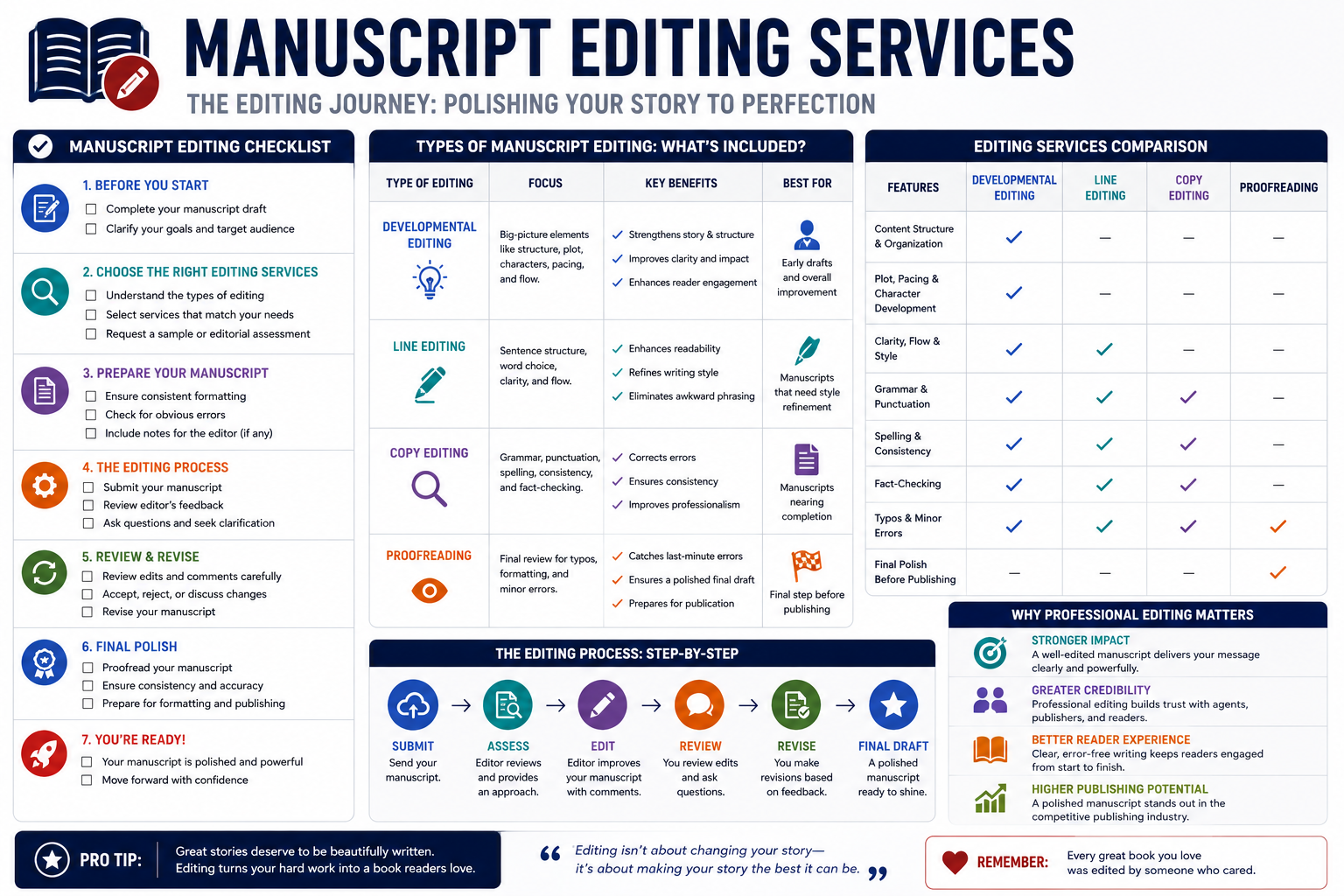
Manuscript editing focuses on improving a written manuscript before publication. It can include developmental editing at the big-picture stage, a structural edit to assess story shape and flow, a line editor’s sentence-level refinement after major revisions, and a copy editor’s final attention to clarity, consistency, and correctness. Depending on the project, editorial attention may include structure, organization, clarity, consistency, development, and other book-level concerns.
When should I hire a professional manuscript editor?
Authors with a complete or near-complete draft may consider a professional manuscript editor when they want an objective editorial perspective before final polishing and publication preparation. If you’re looking for a good editor, ask other writers for referrals so you can compare communication style, genre fit, and whether the editor respects your voice. When reviewing freelance editors, start with established editor directories and platforms such as Reedsy. Before hiring, check for relevant experience, credentials, or academic degrees where appropriate.
Is manuscript editing the same as proofreading?
No. Proofreading generally occurs later and focuses on final spelling errors, grammar mistakes, and grammar issues. Manuscript-level editing can address broader concerns earlier, before the final proofreading stage.
What is book manuscript editing?
Book manuscript editing is professional editorial work focused on a book manuscript. The appropriate approach depends on the genre, audience, purpose, and condition of the draft. Depending on the service selected, book editing may cover the entire manuscript rather than just isolated chapters.
What is a manuscript review service?
A manuscript review service provides professional evaluation of a manuscript to identify editorial concerns and help determine what attention the draft may need next.
Do fiction and nonfiction manuscripts need different editing?
They can. Fiction, nonfiction, memoir, and other types of books may present different structural and editorial needs. The appropriate editing should reflect the individual manuscript.
Will professional editing change my writing voice?
The purpose of editing should be to strengthen the manuscript while respecting the author's intended voice and direction. The specific editorial approach depends on the project.
Should manuscript editing happen before copy editing and proofreading?
When a manuscript still has structural, developmental, organizational, or other larger editorial concerns, those issues generally deserve attention before final polishing, starting with developmental editor work, then line editing, and finally copy editing before proofreading. Some books benefit from a full edit or multiple rounds before they are ready for proofreading.
Does Masterly Publishing offer manuscript editing services?
Authors with complete or near-complete books can contact Masterly Publishing to discuss their manuscript, editorial goals, and manuscript editing services needs. Support may include professional book editing services for self published authors as well as authors pursuing a traditional publisher. The best fit can also depend on manuscript length or word count, since scope affects editorial planning.
Request a Manuscript Evaluation from Masterly Publishing
You have already done the difficult work of getting your book onto the page. Before investing in final polishing and publication preparation, make sure the manuscript itself is ready for that stage.
Masterly Publishing provides professional manuscript editing services for authors who want an experienced editorial perspective on a complete or near-complete book. Whether you are early in your writing journey or preparing for publication, Masterly Publishing can serve as a pro editor partner focused on what your book needs next.
Bring us your manuscript. We can discuss its current stage, your publishing goals, and the editorial support it may need before final copy editing and proofreading, so you can move forward with an edited manuscript and more confidence in the next stage.
Early editorial work can prevent delays later by identifying major problems sooner.
Visit MasterlyPublishing.com or call (888) 209-4055 to request a manuscript evaluation from Masterly Publishing.