



Acknowledgements in a Book: What to Include and How to Write Them
The acknowledgements in a book are a short section where the author thanks the people who helped the book come to life: family members, friends, editors, the publishing team, early readers, and anyone whose support or expertise shaped the work. A good acknowledgments page is sincere, specific, and brief, usually one to three pages.
Some readers skip it, but the people named in it always read the acknowledgments first. For many authors, the acknowledgments section is the most personal page in the entire book. This guide explains what to include, where the acknowledgments page goes, how it differs from a dedication, how to write acknowledgments step by step, and the common mistakes to avoid.

What Are Acknowledgements in a Book?
An acknowledgments page is a formal thank-you. They give the author a public and permanent forum to recognize the people who contributed to the writing process, from the first idea to the finished manuscript and final production.
You will see two spellings. "Acknowledgments" is the standard spelling in American English, and "acknowledgements" is common in British English. Both are correct. Choose one and use it consistently, including in the table of contents.
An acknowledgements page or acknowledgements section is optional. Most books include one, but there is no rule that you must. Short books, some fiction, and some business books skip it or fold a brief thank-you into the preface.
Where Does the Acknowledgments Page Go?
The acknowledgments section can appear in either the front matter or the back matter of a book:
- Front matter. In many nonfiction and academic books, the acknowledgments page appears near the preface or introduction. Some authors include acknowledgments as part of the preface.
- Back matter. In most trade fiction and many popular nonfiction titles, acknowledgments appear at the end of the book, after the final chapter and before the "About the Author" page.
Placing acknowledgments at the back keeps readers moving into the book quickly, which is why many publishers prefer it. For a full view of the order of opening pages, see our guide to book front matter.
Acknowledgments vs. Dedication: What Is the Difference?
A dedication and an acknowledgments page are easy to confuse, but they serve different purposes:
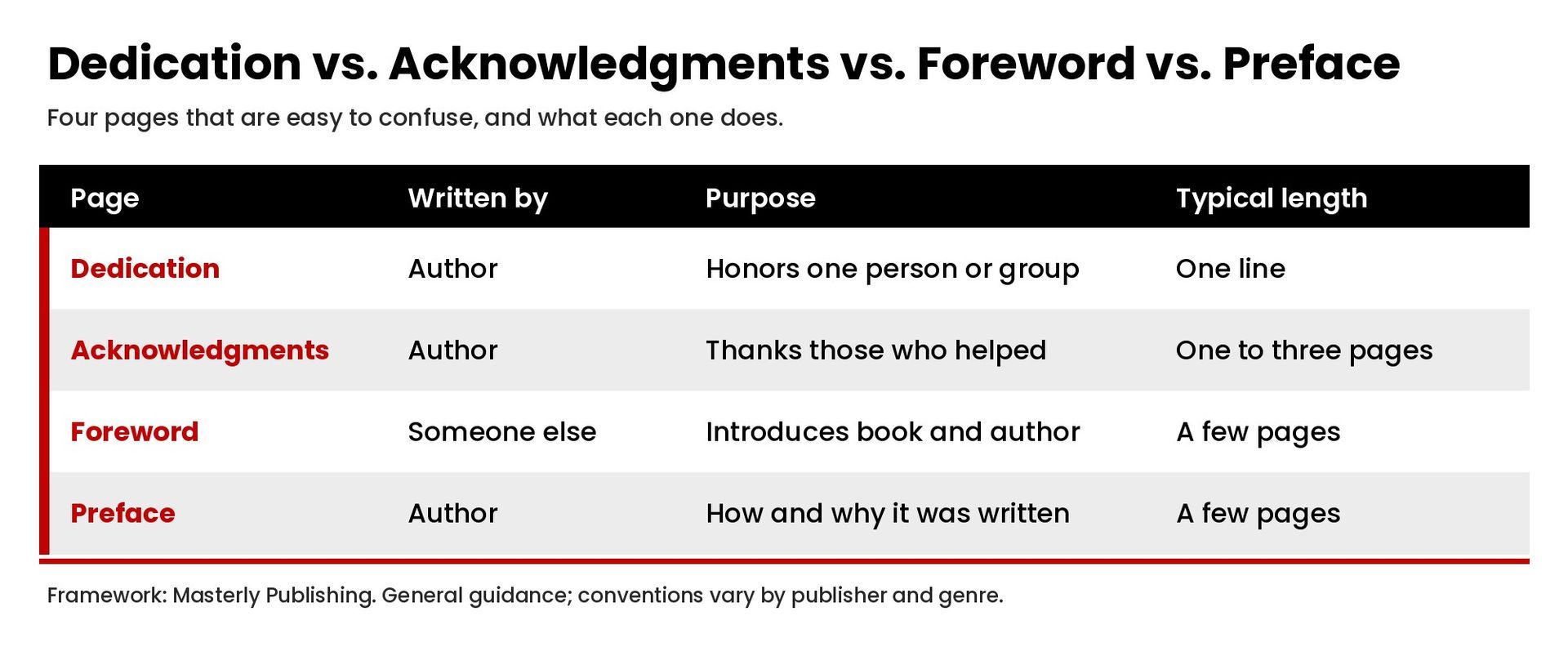
- Dedication. A short line, usually to one person or a small group, placed at the very front of the book. It honors someone meaningful to the author, whether or not they helped with the book. Our guide to writing a book dedication covers it in detail.
- Acknowledgments. A longer section, often a page or more, that thanks the specific people who helped create the book.
- Foreword and preface. These are different again. A foreword is written by someone other than the author, and a preface explains how and why the author wrote the book. Our guide to foreword vs. preface explains both.
Who Should You Thank in Your Acknowledgments?
Most acknowledgments thank a few common groups of people. You do not need to name everyone, but these are the people most authors include:
Your publishing team
Thank the professionals who turned the manuscript into a book: your literary agent, acquiring editor, production editor, copy editors, editorial assistant, cover designer, and the wider book publishing team. If you self-published, thank your editor, designer, formatter, and anyone who helped with the launch.
Early readers and fellow writers
Thank beta readers, critique partners, other writers, and friends who spent time reading early drafts. Their feedback often shaped the book more than readers will ever know. If you worked with test readers, our guide to beta readers explains how they help.
Experts and sources
For nonfiction, thank the experts, interviewees, researchers, and organizations that shared knowledge or access. A business executive writing a leadership book, for example, might thank the colleagues and clients whose stories appear in it, with their permission.
Family and friends
Thank family members, close family, best friends, friends and editors who doubled as cheerleaders, and anyone who supported you while you started writing, kept writing, and finished. Many authors thank a spouse or partner last, as a closing note.
Mentors and influences
Thank the teachers, mentors, and leaders who shaped your thinking or encouraged you to write.
Readers
Some authors end by thanking the reader. It is a simple, generous way to close.
How Do You Write Acknowledgments?
Writing an acknowledgments page is easier with a simple process.
1. Keep a running list
Start a list the day you start writing. Add names as people help: the friend who read an early chapter, the expert who answered a question, the editor who fixed the structure. By the time the book is finished, you will have a complete list instead of trying to remember everyone at the last minute.
2. Group people logically
Organize the acknowledgments section by group, such as publishing team, early readers, experts, and family, or follow the order of the writing process from idea to publication. A clear structure helps the section read smoothly.
3. Be specific
"Thank you to everyone who helped" is a blanket acknowledgment that means little. "Thank you to Maria, who read three versions of chapter four and told me the truth each time" means a great deal. A short, specific detail shows the person exactly what their help meant.
4. Match the tone of the book
A business book can use a warm, professional tone. A memoir can be more emotionally powerful. A humorous book can be funny. Sincerity means honestly reflecting your voice, whatever it is.
5. Keep it to a page or two
Most book acknowledgments run one to three pages. If your acknowledgments section is much longer, look for places to combine names into a group or cut detail.
6. Thank the individuals, not just the roles
Where you can, name all the individuals who mattered, such as the friends and editors who read early drafts or the publishing manager who kept the schedule on track. Naming a person, rather than a role, makes the acknowledgements page feel personal.
7. Check names and spellings
Confirm the spelling of every name and the correct titles, and ask permission before naming anyone who might prefer privacy. Getting a name wrong in print is permanent.
What Do Good Book Acknowledgments Look Like?
Here is a short, illustrative example of book acknowledgments for a nonfiction business book, written to show structure rather than to copy word for word:
Writing this book took far more than one person. Thank you to my editor, whose questions made every chapter clearer, to the cover designer who gave the book its face, and to the entire publishing team for turning a finished manuscript into a book I am proud of.
Thank you to the leaders who shared their stories and trusted me to tell them accurately, and to the colleagues who read early drafts and gave honest feedback.
To my family, thank you for your patience through the early mornings and late nights. And to every reader who picks up this book: thank you for your time. I hope it helps.
This good example of an acknowledgments section is brief, organized by group, and specific enough to feel personal without naming dozens of people.
What Mistakes Should You Avoid in an Acknowledgments Section?
Avoid these common acknowledgments mistakes:
- Forgetting key people. Leaving out your editor, agent, or a major contributor can hurt relationships. Keep a list from the start.
- Going on too long. A five-page acknowledgments section tests even the most patient reader. Aim for only one page if you can, and no more than three.
- Being vague. Generic thanks feel hollow. Add one specific detail for the most important people.
- Using inside jokes nobody understands. A little personality is fine, but readers should not feel excluded.
- Settling scores. The acknowledgments page is for gratitude, not for addressing old disagreements.
- Naming people without permission. Some contributors, sources, or clients may prefer not to be named in print.
- Leaving out mentors. Great leaders and teachers who shaped your thinking deserve a line in the acknowledgments section.
- Writing it at the last minute. Rushed acknowledgments are where names get forgotten and spelled wrong.
How Are Acknowledgments Different in a Business Book?
The business version of an acknowledgments page tends to be shorter and more professional than the acknowledgments in a memoir or novel, but the principles are the same.
- Thank the team behind the ideas. If the book is a leadership manifesto or a guide meant to mentor future leaders, thank the colleagues, clients, and great leaders whose examples shaped it.
- Credit book production. Thank the publishers, editors, and designers involved in book production. Many authors write one paragraph acknowledging the whole production team, then name a few people individually.
- Thank agents past and present. If you changed representation during the project, it is gracious to thank your current agents and, where appropriate, an old agent who helped the book get started.
- Stay specific. Deeply thanking a person for one concrete contribution, such as "the editor I trust to tell me when a chapter is not working," reads better than a list of titles.
Acknowledgments in business books also invite more comments from colleagues and clients after publication, so check every name and title carefully.
How Do You Write Acknowledgments for Your First Book?
If this is your first book, the list of people to thank can feel long, because so many people helped you learn how a book gets written and published. A few tips help:
- Thank all the people who had direct contact with the manuscript. Editors, readers, and designers come first, because their work is in every page.
- Group the wider circle. A great group of supporters, such as a writing community or a team at work, can be thanked together so each person can feel contributed without a long list of names.
- Write a complete thanks list, then edit it. Write everything down first, then cut to the names and details that matter most.
- Read the acknowledgments in books you admire. A good example from a book in your genre will show you the expected length and tone.
Writing acknowledgments for a first book is also a chance to thank the people who believed in you before anyone in the publishing world knew your name.
Do All Books Need Acknowledgments?
No. Acknowledgments are optional. Almost any book can include one, and most books do, but some authors keep the page out to maintain a clean reading experience, especially in short fiction. If you are unsure, consider who would feel left out if the page were missing. For most authors, the answer makes the choice easy.
Frequently Asked Questions
Is it acknowledgments or acknowledgements?
Both are correct. "Acknowledgments" is standard in American English, and "acknowledgements" is common in British English. Choose one spelling and use it consistently.
How long should an acknowledgments section be?
Most acknowledgments sections run one to three pages once published. Many authors aim for a single page and group people where possible.
Does the acknowledgments page go at the front or back of a book?
Either. Many nonfiction and academic books place them in the front matter, while most trade fiction and many popular nonfiction books place them in the back matter.
Who do you thank first in book acknowledgments?
There is no fixed rule. Many authors start with the publishing team or the people most involved in the book and end with family or the reader.
Can I thank readers in the acknowledgments section?
Yes. Thanking the reader is a common and gracious way to close the acknowledgments section.
Finish Your Book With Care
The acknowledgments page is a small part of a book once it is published, but it is the part the people who helped you will read first. If you are preparing a manuscript for publication and want support with editing, front matter, design, and production, contact Masterly Publishing to talk through your next step.