

Book Proofreading Services: What Should Be Corrected Before Final Publication
If your manuscript has already been through developmental editing, copy editing, and design, you are closer to publication than most authors ever get. But there is one step left. Book proofreading services represent the final quality-control stage-a careful, page-by-page review of the typeset or formatted document before it reaches readers. Proofreading is essential for all traditionally published books, and it is equally critical for every self published book entering the market today.
This article explains what should be corrected at this stage, how a professional proofreader differs from earlier editing services, and when to schedule a final proofread. A polished manuscript enhances reader perception and engagement, while a single spelling error on a back cover or in an opening chapter can undermine trust and reviews-even when the story and overall structure are strong. Professional proofreaders catch errors that authors often miss, and skipping this step risks costly mistakes in published works.
If your book is fully edited and you are preparing files for print or ebook upload, you can request a proofreading and publication-readiness review from Masterly Publishing today.
Editing vs. proofreading: What changes at the final proof stage?
Many authors use the words editing and proofreading interchangeably. In practice, they describe different tasks at different points in the publishing timeline.
Proofreading is the final stage of the editing process. It occurs only after all editing revisions are complete. Here is how the two stages compare:
- Developmental editing and line editing focus on content, voice, pacing, and clarity. Editing occurs after completing the first draft and can involve significant revisions to the text. In editing, understanding the manuscript's structure is crucial-plot consistency, character arcs, chapter order, and argument logic are all open for change.
- Book proofreading is the final step before publishing. Proofreading targets surface errors like spelling and grammar, along with punctuation errors, capitalization inconsistencies, and formatting issues introduced during typesetting or ebook conversion. The proofreader works on the typeset proof or final layout-usually a PDF or prepress file-so they see exactly what readers will see.
Editing focuses on content, structure, and clarity. Proofreading focuses on surface errors like grammar and punctuation. The two are complementary, not interchangeable. Skipping the final proofread means relying on layout artists and automated tools, which regularly miss small but visible mistakes. Proofreading should only occur after all editing is complete and the text is considered locked.
What a professional book proofreader actually corrects before print
A professional book proofreader works through a systematic checklist designed for book publishing quality control. A systematic approach improves error detection during proofreading and ensures nothing visible slips into the final publication. Here is what that checklist covers:
- Language accuracy: Correcting remaining spelling errors (including US vs UK consistency), grammar errors, subject–verb agreement problems, pronoun clarity issues, and punctuation errors-dialogue commas, em dashes, ellipses, and whether a punctuation mark falls inside or outside quotation marks per the chosen style guide.
- Mechanical elements: Checking capitalization rules for chapter titles and subheads, consistent treatment of key terms, numerals versus words for numbers, and hyphenation patterns across the manuscript, including catching potential run on sentences that survived earlier passes.
- Formatting and layout: Reviewing page headers and footers, running heads that match chapter titles, page numbering continuity, widows and orphans, extra spaces, and alignment issues introduced during design. These are missing elements that only appear in typeset proofs.
- Consistency across the book: Verifying character names, place names, dates, timelines, recurring terms, and series continuity-especially important for multi-book projects.
- Factual slips: Flagging obvious contradictions (a date in chapter twelve that conflicts with chapter three, for example) without performing full fact-checking or restructuring the narrative.
- Non-fiction specifics: Checking table of contents alignment, figure and table labels, cross-references like "see Chapter 4," and bibliography formatting for obvious errors.
The best proofreading services maintain consistency and preserve the author's voice throughout this process. Proofreaders should deliver their work using track changes for clarity, so every correction is transparent. Proofreading improves the chances of manuscript publication by ensuring the edited document is genuinely ready for readers.

When to schedule book proofreading in your publishing timeline
Consider an author who finishes final revisions in January, sends the manuscript to a designer in February, and plans a spring release. Where does proofreading fit?
The typical sequence looks like this:
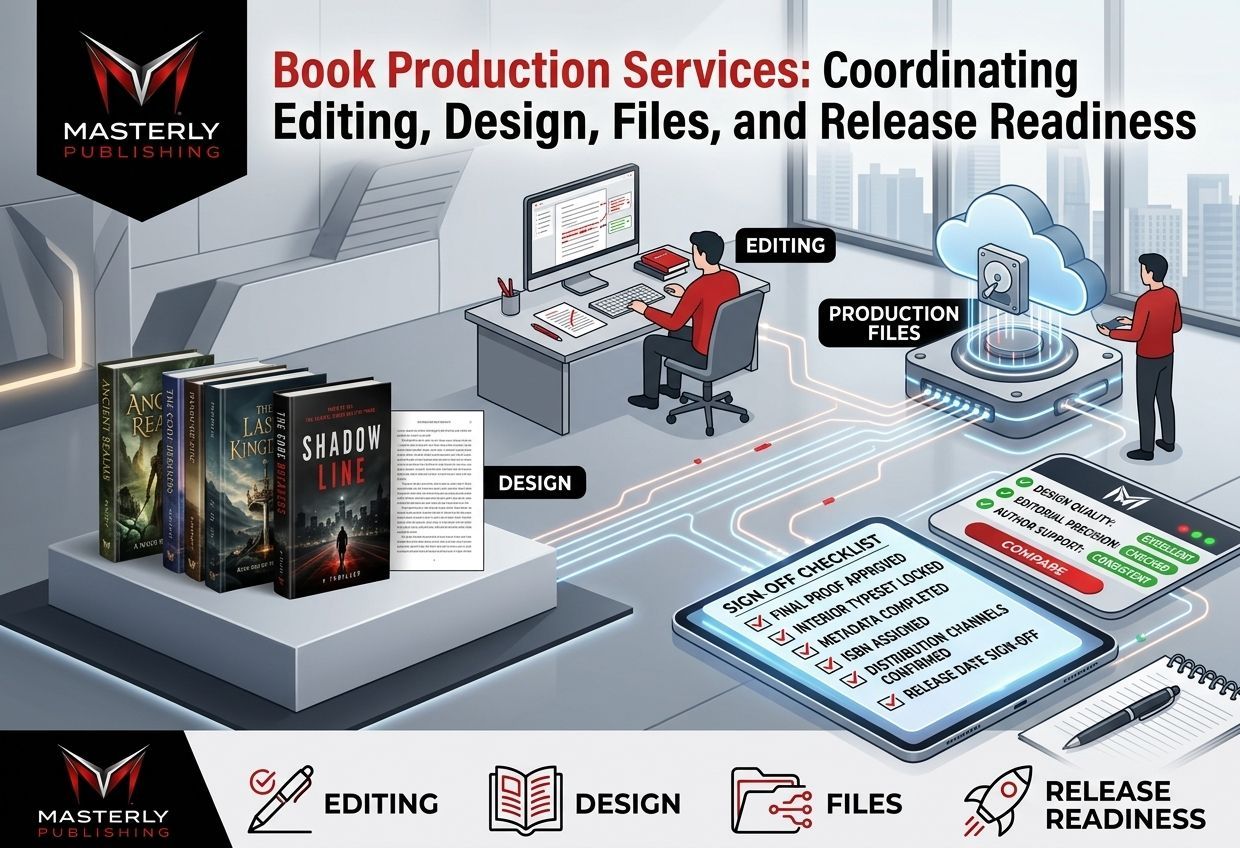
Finish manuscript → developmental or structural edit → line editing or copy editing → author revisions (the revision process) → design and typesetting → final proofread → upload to printer and ebook platforms.
Book proofreading services should be booked after editing is complete and the text is locked, but before sending final print-ready files to platforms like IngramSpark, KDP Print, offset printers, or corporate print vendors. Manuscripts require proofreading before publishing to avoid errors that are expensive or impossible to fix after release.
For a 60,000–80,000 word count book, plan for a turnaround time of at least five to seven business days for professional proofreading, plus extra days to implement corrections and recheck high-risk pages such as front matter, the copyright page, and back cover copy.
Organizations publishing reports, annual histories, or legacy books often have fixed launch dates tied to conferences or events. Reserve proofreading time in your production calendar several months in advance.
Most people spend only a few minutes proofreading their own writing. That is not enough for a book-length document. If substantial editorial changes are still expected, the manuscript belongs in an editing service, not in a final proofread.
Proofreading for different book types: Fiction, non-fiction, and organizational projects
Manuscript proofreading needs vary by project type. A novel, a business book, and an organizational history each present different challenges at the proof stage.
For fiction-novels, novellas, short stories, and an essay collection-the proofreader focuses on dialogue punctuation, internal thought formatting, character name consistency, invented-world terminology, and timeline clarity. If a scene is set in "October 2024," earlier date markers in the story must align. Genre-specific proofreaders understand conventions unique to that genre, whether romance, thriller, or literary fiction.
For non-fiction-business books, memoirs, how-to guides, and even a research paper or thesis adapted into book form-the proofreader checks chapter headings, subhead hierarchy, numbered steps, sidebars, callouts, and index entries against the final layout. Academic and nonfiction books require familiarity with citation styles. Proofreading services can enhance essays and research papers as well as full-length books, and they are available for academic papers and theses. Terminology consistency matters here: is it "email" or "e-mail" throughout?
For organizations-associations, universities, ministries, and companies-specific needs include proofing forewords, acknowledgment pages, board lists, statistics labels, captions, and sponsor names. Errors in these sections can cause reputational embarrassment. Business documents include reports, presentations, and web content, and proposals need proofreading to secure funding or approval. The same care applies to a published book carrying an organization's name.
Translated books, multi-author collections, and co-branded publications often require extra consistency passes to resolve differences in writing style between contributors. Masterly Publishing's professional proofreaders are accustomed to working with both author-led projects and committee-reviewed manuscripts, clarifying comments carefully so decision-makers can approve each change.
How Masterly Publishing's book proofreading services work from first contact to final files
Understanding the proofreading process from the first step to final delivery removes uncertainty. Here is how the editing process works at Masterly Publishing:
- Initial contact: The author or organization reaches out via the Masterly Publishing website, calls (888) 209-4055, or emails to request a proofreading and publication-readiness review. They share the word count, genre, and planned release date. Clear communication is essential for successful proofreading projects.
- Sample review: The team reviews a sample of the pages-usually a chapter and several layout pages such as front matter or back cover copy-to confirm the manuscript is ready for proofreading rather than earlier book editing services. This is the point where you submit your materials.
- Proofreader matching: A professional book proofreader is matched based on genre, document type, and required file format (Word, InDesign-exported PDF, or ebook proof files such as EPUB). Schedule and scope are confirmed in writing. Established editing agencies have a roster of experienced editors, and finding a reliable proofreader depends on several factors including subject expertise and availability.
- Proofreading execution: The proofreader completes a first pass for language and mechanical accuracy, then a second pass for layout-related issues and consistency. Deliverables include a clean "ready to implement" file plus a tracked-changes version.
- Summary and handoff: A brief summary note highlights recurring issues caught-hyphenation choices, capitalization of key terms, formatting patterns-so the author or designer knows exactly what was addressed before files go to print or distribution.
All client work is treated as confidential. The proofreader respects authorial voice and does not rewrite or recast the book's language at this stage. Professional editors at Masterly Publishing handle files securely without claiming ownership.

What authors and organizations should check before booking a proofread
A checklist before hiring a proofreader can ensure quality and fit. Before investing in professional proofreading, verify the following about your manuscript and your provider:
- Content is finalized. Confirm that the story or argument is complete, that previous editing rounds (developmental editing or copy editing) are done, and that no major structural changes are planned.
- You have reviewed it yourself. Read a printed or PDF version of your manuscript once to catch obvious issues with headings, missing pages, or misordered chapters. Even a quick personal statement of readiness helps.
- Style preferences are documented. Decide on US vs UK spelling, preferred style guide (Chicago Manual of Style is standard for most trade books), and how to handle numbers, italics, and foreign terms. This gives the proofreader a clear reference.
- You have asked the right questions. When evaluating any provider, ask who will handle your book-a named professional proofreader or an anonymous pool. Choosing a proofreading service requires checking qualifications and sample edits. Red flags in choosing a proofreader include vague service descriptions and an inability to explain scope. Reviewing independent reviews provides insights into a proofreader's quality.
- Last-minute elements are collected. Gather your dedication, acknowledgments, author bio, website URL, and social media handles before the proofread begins so that late additions do not introduce fresh errors.
- Approvals are in place. For organizations with internal review cycles, secure sign-off on sensitive phrasing-executive messages, legal language-before the proofreader begins.
Authors should look at trusted directories to find vetted professionals. Reliable proofreading options include various platforms and directories. Curated freelance marketplaces help find individual proofreading professionals, and professional freelance directories list vetted proofreaders for book-length manuscripts. Confidentiality and file security should be confirmed with any proofreading services provider you consider.
Free samples, style compatibility, and working with a professional book proofreader
The relationship between author and proofreader matters. A cover letter introducing your project and a brief conversation about expectations can prevent misunderstandings and wasted time.
A short free sample or paid sample edit on one to three pages demonstrates how a professional book proofreader marks corrections, queries unclear sentences, and respects the author's established voice. Reputable proofreaders provide sample edits to demonstrate their skills-this is a helpful indicator of quality. Masterly Publishing can provide a limited sample review where appropriate, focused on publication-readiness rather than re-editing the whole manuscript.
Style compatibility means the proofreader follows agreed style rules, points out inconsistencies, and offers gentle suggestions without recasting the book's tone or message. The proofreader preserves your writing style and does not introduce passive voice or unfamiliar phrasing where you have made deliberate choices. This is different from earlier feedback an editor might give on overall structure or clarity.
Ask practical questions during the initial conversation: preferred file formats, how comments appear (Track Changes or PDF annotations), turnaround time for a book of your length, and how to handle post-proof queries.
For context, well-known services in the broader market set high bars. All ProofreadingPal editors are native English speakers, and many ProofreadingPal editors hold a master's or PhD in English. ProofreadingPal uses a two-proofreader model for every document. Scribbr editors have a passing rate of only 2% in their academy, and Scribbr editors are matched based on field of study and document type. These benchmarks illustrate the level of rigor you should expect from any provider you hire.
Unlike quick edits on business documents, a personal statement, or a cover letter, book proofreading involves careful, page-by-page review of a large volume of text. Realistic schedules and expectations are essential for quality. The least amount of time you should allow is enough for the proofreader to read every line without rushing.
Frequently asked questions about book proofreading services
Is proofreading the same as editing? No. Proofreading is the final step in the editing process, focused on surface errors after earlier content and structure edits are done. Editing can involve significant revisions, while proofreading corrects what remains-spelling, punctuation, grammar, and formatting on the near-final page.
How long does a final proofread take for a typical book? It depends on length and complexity. For a standard 60,000–80,000 word manuscript, plan for at least five to seven business days. Longer works, heavily formatted non-fiction, or rush timelines will adjust the cost and schedule accordingly.
Can you proofread my book after it is typeset? Yes. Most professional proofreaders, including Masterly Publishing, prefer to work from the same layout files going to print-usually PDF-so they see exactly what readers will see. Ebook files (EPUB) can also be reviewed.
What if I decide to make big changes after proofreading? Significant rewrites may require additional proofreading or a return to an editing service, because new text introduces fresh errors and grammatical errors that were not in the original proofread.
Will you keep my manuscript confidential? Masterly Publishing treats client work as private, respects copyright, and uses secure handling of files without claiming ownership.
How do I budget for book proofreading services? Consider your word count, schedule, and whether you need a single proofread or a full publication-readiness review that includes back cover copy, front matter, and promotional language. Proofreading is the final step before publishing, and budgeting for it protects every dollar you have already spent on writing, editing, and design.
How to request a proofreading and publication-readiness review from Masterly Publishing
If your manuscript has already been edited and designed, the final missing step is a professional proofread. This is where you protect the investment of time, budget, and reputation you have already made. Proofreading helps avoid costly mistakes in published works, and a correct, clean book earns the reader trust that drives reviews and sales.
Here is your next step:
Visit Masterly Publishing Group to describe your project or upload a sample.
Call (888) 209-4055 to discuss a tailored book proofreading plan.
Request a "book proofreading and publication-readiness review" covering interior pages, front and back matter, and critical marketing copy such as your back cover description and author bio.
The team will help determine whether your manuscript is ready for final proofreading or if it should first pass through another stage of book editing. You will not pay for the wrong service.
A careful final proofread is the last quiet step before sharing your book confidently with readers, reviewers, and stakeholders.