



How to Write a Book Introduction That Hooks Readers
To write a book introduction, tell readers who the book is for, what problem it addresses, why you are the right person to write it, and what they will gain by reading, then preview how the book is organized and end with a clear invitation to keep reading. A strong introduction is short enough to read in one sitting, specific about who it serves, and written, or at least rewritten, after the rest of the book is finished. In a nonfiction book, the introduction is often the page that convinces a browsing reader to buy.
This article explains what a book introduction should do, how it differs from a preface and a first chapter, a simple outline you can follow, an example, five tips for writing an introduction, and mistakes to avoid.

What Is a Book Introduction?
A book introduction is the opening section of a book that prepares readers for the main text. It sets up the subject, the promise of the book, and the reader's path through it. In nonfiction, the introduction is usually considered part of the main body of the book, while a preface or foreword belongs to the front matter. Our book publishing services article explains how these pieces come together in the finished book.
Introduction vs. Preface vs. First Chapter
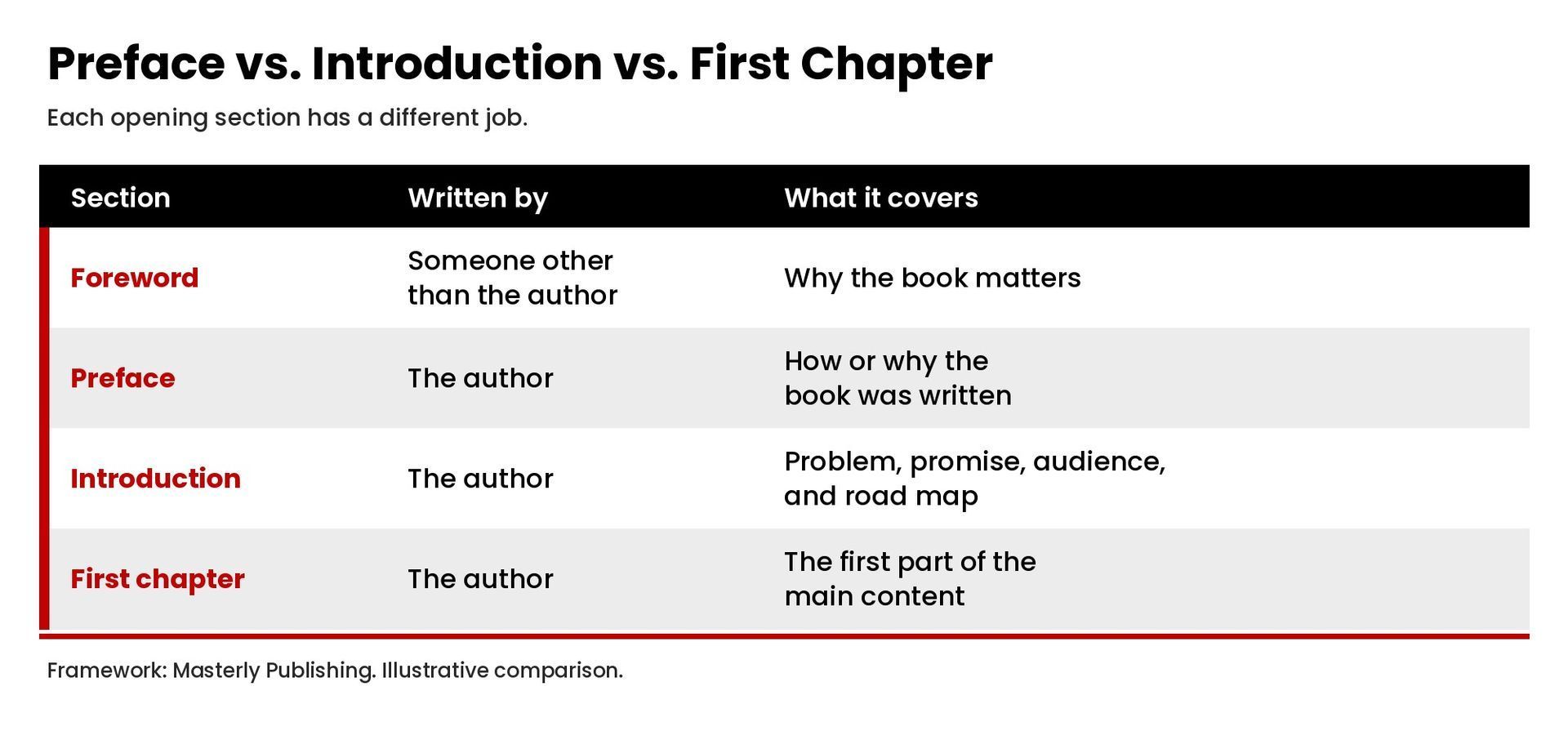
These terms are often confused:
- Preface. Written by the author, usually about the book itself: why or how it was written, the research behind it, or acknowledgments of scope. It sits in the front matter.
- Foreword. Written by someone other than the author, often a respected voice in the field, explaining why the book matters.
- Introduction. Written by the author, about the subject: the problem, the promise, the intended audience, and how the book is organized.
- First chapter. The start of the book's actual content. It delivers material; the introduction prepares readers for it.
If your introduction is starting to teach the book's main ideas in depth, that material may belong in chapter one instead. Fiction has its own version of this choice: some novels open with a prologue, a scene set apart from the main story, rather than an introduction.
What a Book Introduction Should Include
Most effective nonfiction introductions cover these elements:
- A hook. A story, question, or problem that pulls the reader in.
- The problem. What your readers struggle with, in terms they recognize.
- The promise. What readers will understand, be able to do, or gain by the end of the book.
- Your credibility. Why you are qualified to guide them, stated briefly and specifically.
- Who the book is for. A clear description of the potential reader, and sometimes who it is not for.
- The road map. A short preview of how the book is organized.
- An invitation. A closing line that leads into chapter one.
A Simple Book Introduction Outline
If you are not sure where to start, a clear outline makes writing an introduction much easier. Most authors can build a first draft from these six parts, in this order:
- Opening moment. Begin with a short story, a question, or a situation your readers will recognize from their own life or work.
- The problem and its context. Explain what is at stake and why the problem matters now. Give enough background that readers understand the context, but no more.
- Why the usual solutions fall short. Show readers you understand what they have already tried.
- What this book offers. State the promise in plain language: what readers will know, do, or overcome by the end.
- Why you. Establish your expertise and authority in two or three specific sentences. Point to your experience, research, or results rather than adjectives.
- How the book works. A short road map of the parts or chapters, then a line that invites readers to turn the page.
Each part can be a paragraph or two. Once the outline is filled in, read it from the point of view of a potential reader in a bookstore: does it make sense, and does it make them want to keep reading?
A Book Introduction Example
Here is a short, illustrative example written for this article. It is for an imagined business book for first time managers, and it shows how the outline above can work in practice:
You were promoted because you were good at your job. Then, on your first Monday as a manager, you realized the job had changed completely. The skills that made you successful are no longer the ones your team needs from you.
If that sounds familiar, this book is for you. If you were handed the title without much guidance, you have probably been learning by trial and error, and so has your team.
This book is a practical guide to your first year as a manager. In the chapters that follow, you will learn how to run one on one meetings, give feedback people can use, delegate without losing control, and handle the conversations most managers avoid.
The book is organized in three parts: leading yourself, leading individuals, and leading a team. Each chapter ends with a short exercise you can use the same week. Start with Part One, or turn to the chapter that matches the problem in front of you today.
Notice what the example does: it opens with a moment the reader recognizes, names the problem, makes a specific promise, explains the structure, and invites the reader in. In a real book, the author would also add a few sentences establishing their own experience and authority.
Five Tips for Writing an Introduction
1. Write it last, or rewrite it last
Many authors draft an introduction early to clarify their thinking, which is useful. But the book usually changes as you write it. Revisit the introduction after the manuscript is complete, so the promise and road map match what the book actually delivers.
2. Be specific about your intended audience
Readers want to know quickly whether a book is for them, and a well crafted introduction answers that on the first page. Describe the reader in concrete terms: their role, their situation, or the problem they face. A specific audience makes the introduction more persuasive, not less.
3. Lead with the reader, not yourself
Credibility matters, but readers care first about their own problem. Start with their situation, then explain briefly why you can help. Save the full author story for later in the book or the author bio.
4. Keep it short
An introduction should prepare readers, not delay them. Aim for something a reader can finish in one sitting. If it runs long, look for material that belongs in chapter one, and break long sections into shorter paragraphs.
5. Make a promise the book keeps
The introduction sets expectations. Do not promise outcomes the book cannot deliver. Every claim in the introduction should be supported somewhere in the chapters that follow, so the entire book delivers on its first pages.
Writing an Introduction for a Business or Expert Book
Business books, professional guides, and other expert nonfiction have a specific job: the introduction has to show that the author has real knowledge and that the book offers practical solutions. A few points help:
- Lead with the business problem. Name the cost of the problem for your reader's company, team, or career.
- Establish authority with evidence. Mention your role, years of experience, research, or client work, and keep it brief.
- Explain the value early. Readers who are busy want to see the benefit before they invest time in reading.
- Show the method. If the book uses a framework or process, introduce it by name and explain that each chapter covers one part.
- Keep the tone engaging. Expert does not have to mean dry. A clear story or example keeps readers interested.
Questions to Answer Before You Start
Before you begin drafting, answer these questions in a sentence or two each. They will shape every paragraph of the introduction:
- Who is the potential reader, and what is going on in their life or work when they pick up this book?
- What problem does the book solve, and what happens if the reader does nothing?
- What will the reader be able to do, understand, or decide after reading?
- Why are you the right person to write it?
- How is the book structured, and where should the reader start?
Common Mistakes in Book Introductions
- Throat clearing. Long warmups before getting to the point.
- Too much backstory. A detailed personal history before readers know why it matters to them.
- Vague audience. Writing for everyone, which connects with no one.
- Summarizing every chapter in detail. A brief road map is helpful; a chapter by chapter summary can make the rest of the book feel redundant.
- Promises the book does not keep. Readers notice when the introduction oversells.
Editing Your Introduction
Because the introduction is so important, it deserves careful editing. An editor can help at two levels. A developmental editor can check whether the promise matches the book's structure, and a line editor can sharpen the opening pages so they read smoothly. See our articles on developmental editing services and book editing services. If you are still drafting, author coaching can help you clarify your audience and promise before you write.
Frequently Asked Questions
How long should a book introduction be?
Long enough to set up the problem, promise, audience, and road map, and short enough to read in one sitting. If it starts teaching the main content, move that material into chapter one.
Should I write the introduction first or last?
Many authors draft it first to clarify their thinking and rewrite it last so it matches the finished book.
What is the difference between a preface and an introduction?
A preface is about the book itself, such as why or how it was written, and sits in the front matter. An introduction is about the subject and prepares readers for the main text.
Does every book need an introduction?
No. Many novels begin directly with the first chapter. Most nonfiction books benefit from an introduction that explains the book's purpose and audience.
What is a good introduction example?
A good introduction example opens with a moment the reader recognizes, names their problem, makes a specific promise, explains how the book is organized, and invites the reader in. The sample business book introduction above follows that pattern.
What should an author include to establish authority?
Include a few specific facts about your experience, such as your role, the work you have done, or the research behind the book. Keep it brief and connect it to the reader's problem.
How do I start a book introduction?
Start with a hook that connects to the reader's problem: a short story, a question, or a situation the reader recognizes.
Write an Introduction That Invites Readers In
A good book introduction tells readers who the book is for, what it promises, and why they should keep reading, then gets out of the way. Write it with your audience in mind, keep it focused, and revise it once the book is complete. For help preparing your manuscript, see our manuscript evaluation services or contact Masterly Publishing.