



Book Front Matter: Pages, Order, and What to Include
Book front matter is everything that appears before the first chapter of a book: the half title page, title page, copyright page, dedication page, table of contents, and optional elements such as an epigraph, foreword, preface, or acknowledgments. Front matter tells readers what the book is, who wrote and published it, and how it is organized, and it follows conventions most publishers draw from The Chicago Manual of Style. Getting the front matter right, in the right order, is one of the clearest signs of a professionally produced book.
This guide explains each front matter element, the typical order, which pages are required and which are optional, how front matter differs from back matter, and what self publishing authors should prepare.

What Is the Front of a Book Called?
The pages before the main text are called front matter, also called preliminary pages, or "prelims" in some publishing houses. Together with the main body of the book and the back matter at the end, front matter makes up the complete interior of a book. In print books, front matter pages are traditionally numbered with lowercase roman numerals, and the arabic numbering begins with the first page of the main text, though page numbers are often not printed on blank pages or display pages such as the title page.
Front Matter Elements in Order
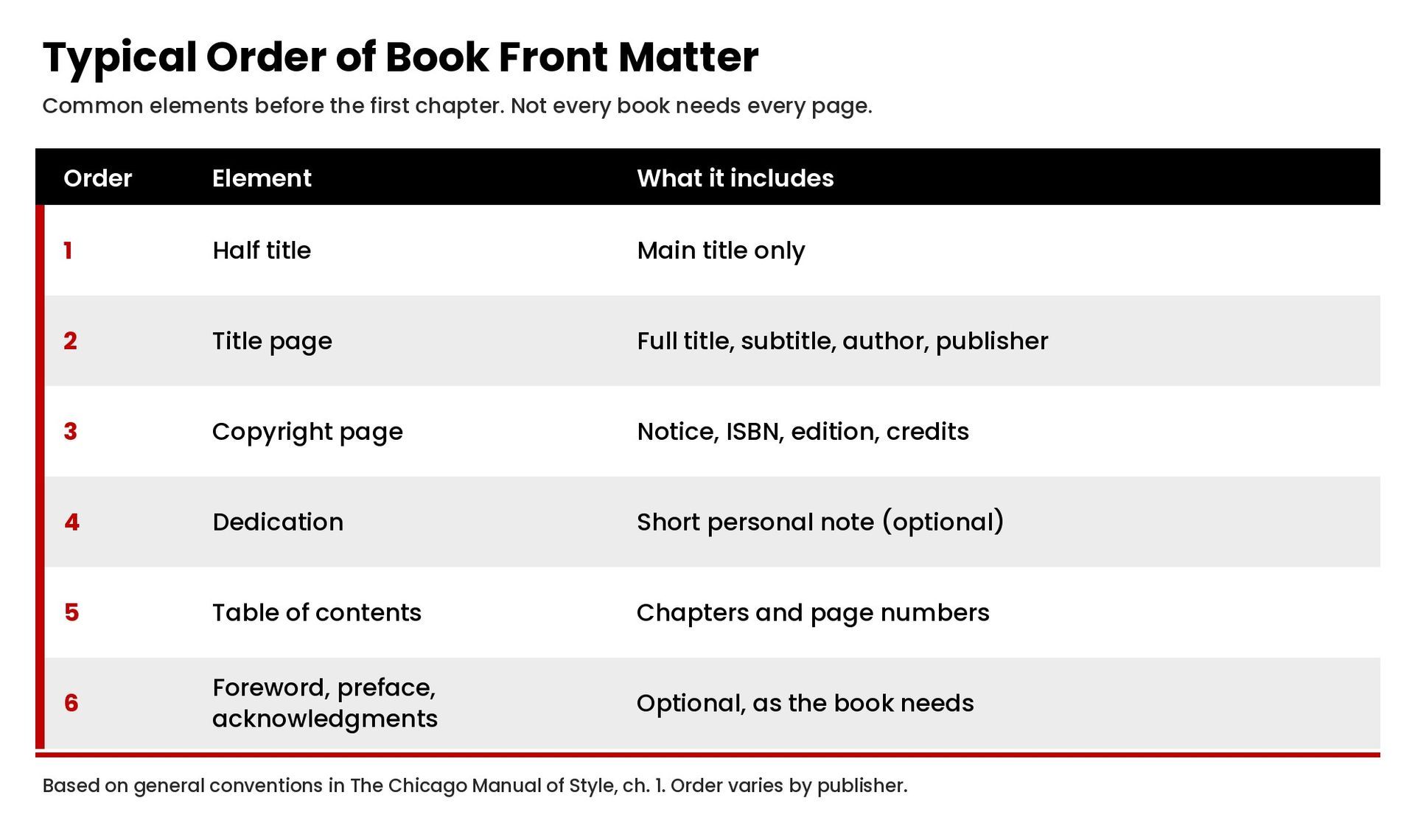
The typical order below follows the general conventions described in The Chicago Manual of Style, chapter 1. Not every book needs every element, and many publishers adjust the order slightly. Elements usually begin on a right hand page (recto), with the copyright page as the main exception.
1. Half title page
The half title page is usually the very first printed page of a book. It carries only the main title of the book, without the subtitle, author name, or publisher. The back of the half title, the blank verso, is often left blank, though some publishers use it for a list of other books by the author, called an "also by" page or author page.
2. Title page
The full title page includes the full title and subtitle, the author name, and usually the publisher's name and location. It is a right hand page. A book designer often uses the same typography as the front cover so the interior and exterior feel consistent.
3. Copyright page
The copyright page appears on the back of the title page. It typically includes the copyright notice, publisher information, the ISBN, edition and printing information, and any credits or permissions. According to the U.S. Copyright Office, a copyright notice generally consists of three elements: the copyright symbol or the word "Copyright," the year of first publication, and the name of the copyright owner. The Copyright Office also notes that notice is optional for works published on or after March 1, 1989, though it offers advantages. For legal language beyond the notice itself, such as rights reservations or disclaimers, consult a qualified professional rather than copying wording from another book. Our guide to ISBN services explains what authors need to know about ISBNs before distribution.
4. Dedication page
The dedication page is a short personal note from the author dedicating the book to a person or group. It usually stands alone on a separate page, a right hand page, with the back left blank.
5. Epigraph
An epigraph is a short quotation that sets the tone for the book. It is optional. If you use a quotation from a work still under copyright, check whether permission is needed.
6. Table of contents
The table of contents lists the major sections and chapters with their page numbers. Most nonfiction books and many novels include one. In ebooks, the table of contents is usually linked so readers can jump to each chapter.
7. Lists of illustrations or tables
Books with many figures, maps, or tables may include lists after the table of contents. These are most common in nonfiction books and academic titles.
8. Foreword
A foreword is written by someone other than the author, often a well known person in the field, and explains why the book matters. It is signed by its writer.
9. Preface
A preface is written by the author and explains how or why the book came to be, its scope, or how to use it.
10. Acknowledgments
Acknowledgments thank the people who helped with the book. Many publishers place them in the front matter; others move them to the back matter.
11. Introduction
An introduction that is essential to the content is often treated as part of the main text rather than the front matter. If the introduction explains the book's argument or sets up the first chapter, it usually belongs in the main body.
What Front Matter Is Required?
For most books, the essential front matter is the title page and the copyright page. A half title page and table of contents are standard in professionally published books and expected by many readers and retailers. Other front matter elements, such as a dedication, epigraph, foreword, or preface, are optional and depend on the book.
For self published books, the safest approach is to include:
- Half title page
- Title page
- Copyright page
- Dedication page (if any)
- Table of contents
- Any foreword, preface, or acknowledgments the book needs
Front Matter vs. Back Matter
Back matter, sometimes called end matter, appears after the last chapter. Common back matter elements include:
- Acknowledgments (if not in the front matter)
- Appendices
- Notes and endnotes
- Glossary
- Bibliography or references
- Index
- Author bio, often a short biography with a photo
- A page about other books or an upcoming book by the author
Front and back matter work together. Front matter prepares readers for the main text; back matter supports it and tells readers where to go next.
Front Matter Tips for Self Publishing Authors
- Follow industry standards. Readers, bookstores, and reviewers notice when front matter is missing or out of order.
- Keep the very first pages simple. Do not crowd the opening pages with too many quotes or notes before the first chapter.
- Check retailer previews. In ebook previews, front matter takes up part of the sample. Keep it lean so readers reach the story or main text quickly, and consider moving some elements, such as acknowledgments or a long author bio, to the back.
- Match your book design. Front matter should match the interior design, trim size, and typography of the rest of the book.
- Proof the front matter carefully. Typos in the title page or copyright page are especially noticeable. Our guide to book proofreading services covers the final check.
If you want help preparing interior files, front and back matter, and release ready files, see our book production services guide.
Frequently Asked Questions
What is the front of a book called?
The pages before the first chapter are called front matter. They include the half title page, title page, copyright page, dedication, table of contents, and optional elements such as a foreword or preface.
What does "front of book" mean?
In publishing, "front of book" refers to the front matter: the preliminary pages that come before the main text.
What is a half title page?
A half title page is the first page of a book, showing only the main title. It comes before the full title page.
Where does the copyright page go?
The copyright page usually appears on the back of the title page, a left hand page, in the front matter.
Does an ebook need front matter?
Yes, but it is usually shorter. Most ebooks include a title page, copyright page, and linked table of contents, and many authors move other elements to the back to keep the preview focused on the main text.
Are front matter pages numbered?
Traditionally, front matter pages are counted with lowercase roman numerals, though numbers are not printed on every page. Arabic page numbers begin with the main text.
Prepare Front Matter That Looks Professional
Front matter is small, but it sets the tone for the whole book. Use the standard order, include the required pages, keep optional elements purposeful, and proof everything carefully. If you are preparing a book for publication, see our book publishing services or contact Masterly Publishing.
Sources: U.S. Copyright Office, Circular 3: Copyright Notice. The University of Chicago Press, The Chicago Manual of Style, chapter 1: Books and Journals.