



How to Write a Book Synopsis: Length, Format, and Examples
A book synopsis is a short summary of your entire book, written for a literary agent, editor, or publisher. It shows the full narrative arc from the opening to the ending, including the twist you would never reveal on the back cover. Many writers find writing a synopsis harder than writing the manuscript itself, because it asks you to compress an entire novel into one or two pages. The good news is that writing synopses gets much easier with a clear process.
This guide explains what a book synopsis is, how it differs from a blurb and a query letter, how long it should be, what to include, and how to write a book synopsis step by step, with tips for fiction and nonfiction authors.

What Is a Book Synopsis?
A synopsis is a summary of your book's story or argument from beginning to end. For a novel, it covers the main character, what they want, the inciting incident, the major plot points, the climax, and the ending. Its purpose is practical: it lets an agent or editor see whether the story is structurally sound, whether the character arc makes sense, and whether the ending delivers on the setup, without reading the entire manuscript.
A synopsis is usually part of a query package in traditional publishing. Some agents ask for one with the query letter and sample pages; others request it later. Always check each agent's or publisher's submission guidelines, since requirements vary.
Synopsis vs. Blurb vs. Query Letter
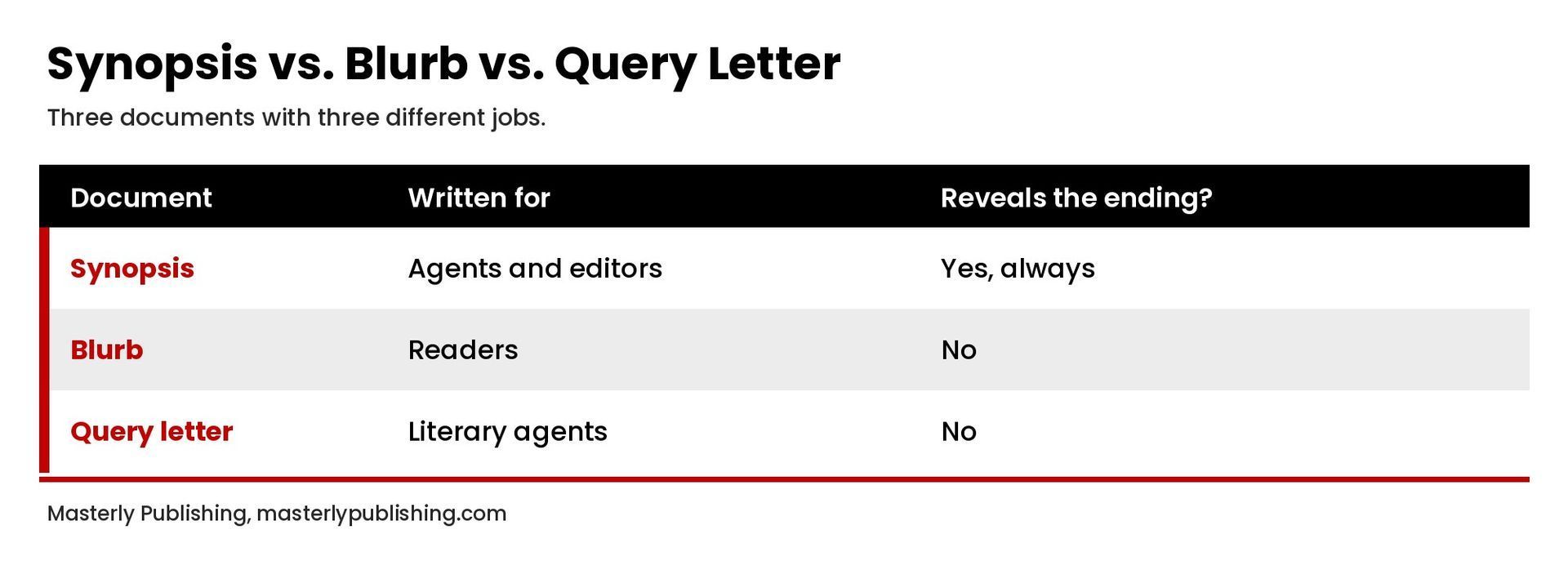
These three documents are often confused, but each has a different job.
- Synopsis. Written for agents and editors. Tells the whole story, including the ending. Focuses on plot and character motivations, not marketing language.
- Blurb. Written for readers. Appears on the back cover or a retail page. Creates curiosity and never gives away the ending. See our guide to the book blurb.
- Query letter. A one page pitch letter to an agent. Introduces the book's hook, genre, word count, and the author, and asks the agent to request the manuscript.
The easiest way to remember the difference: the blurb sells the book to readers, the query letter sells the book to an agent, and the synopsis proves the book works.
How Long Should a Book Synopsis Be?
There is no single required length. Agents and publishers ask for different lengths, and many writers keep two versions:
- A one page synopsis , often around 500 words, single spaced. This is a common request because it is quick to read.
- A longer version of two to five pages, for agents or editors who want more detail.
If the guidelines do not say, a one to two pages synopsis is a safe starting point. Writing different lengths in advance saves time when requests arrive.
What to Include in a Book Synopsis
A strong synopsis for fiction typically includes:
- The main character. Who the protagonist is and what they want at the start.
- The setting. Only as much as the reader needs to understand the story.
- The inciting incident. The event that sets the story in motion.
- Major plot points. The key turning point moments and rising action that move the story forward.
- Character motivations. Why the main character makes their choices, and how they change.
- The climax. The highest point of conflict.
- The ending. How the central conflict is resolved. Do not hide it.
What to leave out: subplots that do not affect the main plot, most secondary characters, detailed descriptions, dialogue, and rhetorical questions such as "Will she survive?"
How to Write a Book Synopsis Step by Step
1. Finish the manuscript first
A synopsis written before the book is finished tends to describe the story you planned, not the one you wrote. Write it once the draft is complete, ideally after revisions based on editor or beta reader feedback.
2. Start with the premise
Before listing events, write one or two sentences that answer a simple question: what is this book about? The premise names the main character, what they want, and what stands in the way. It keeps the rest of the synopsis focused.
3. List the essential plot points
Go through your chapters one by one and write one sentence describing what happens and why it matters. Note the key scene in each chapter. Then mark only the events that change the main character's situation or decisions. Those are the plot points that belong in the synopsis.
4. Write in third person, present tense
Synopsis writing convention is third person and present tense, even if your novel uses first person or past tense. For example: "Maya discovers the letter and confronts her father."
5. Introduce characters clearly
At the first mention of each important character, many writers put the name in capital letters, then use normal capitalization afterward. Name only the characters the reader needs to follow; describe others by role, such as "her editor" or "the detective."
6. Connect events with cause and effect
A synopsis should read like a story, not a list. Use connecting words such as "because," "so," and "but" to show how one event leads to the next. This is what makes the narrative arc visible.
7. Show the emotional arc
Agents want to see how the main character changes, not only what happens. Include the moments where the character's goals or beliefs shift.
8. Reveal the ending
State clearly how the story ends and how the main conflict is resolved. An agent cannot judge whether the ending works if the synopsis hides it.
9. Cut and polish
Remove anything that does not serve the main plot. Read the synopsis aloud. Then ask someone who has not read the book whether the story makes sense from the synopsis alone.
Tips for Writing a Synopsis That Works
- Keep your voice. A synopsis can be plain without being flat. Let a hint of the book's tone come through.
- Focus on the main plot. One or two subplots at most, and only if they affect the ending.
- Avoid vague phrases. "Things get complicated" tells the agent nothing. Say what actually happens.
- Do not editorialize. Skip lines like "in a stunning twist." Let the events speak.
- Keep no secrets. A synopsis is not supposed to create mystery. If a secret drives the plot, explain what it is.
- Stick to the space you have. If an agent asks for one page, a helpful rule of thumb is one paragraph each for the beginning, the middle, and the end.
- Get outside advice. Comments from a critique partner or editor can help you figure out which plot points a reader actually needs.
- Format cleanly. Use a readable font, clear margins, and your name and title in the header, unless the guidelines say otherwise.
Synopsis Examples of What to Write and What to Avoid
Here is a short example of synopsis writing for a hypothetical novel.
Weak: "Maya's life changes forever when she finds something that will test everything she believes. Will she find the truth before it is too late?"
Stronger: "When MAYA REYES, a junior accountant, finds a letter proving her father falsified the family company's records, she must choose between protecting him and reporting the fraud that cost his employees their pensions."
The stronger version names the main character, the inciting incident, the stakes, and the choice that drives the story.
How to Write a Synopsis for a Nonfiction Book
Nonfiction books are usually sold with a book proposal rather than a full manuscript. Instead of a plot synopsis, the proposal includes an overview of the book's argument and a chapter by chapter outline that summarizes what each chapter covers. The same principles apply: be clear, be specific, and show how the book moves from the problem to the reader's outcome. Our guide on how to write a book proposal covers what to include.
Common Synopsis Mistakes
- Withholding the ending to create suspense.
- Including too many characters , which makes the story hard to follow.
- Writing a chapter by chapter list instead of a connected story.
- Using marketing language that belongs in a blurb.
- Ignoring the requested length in an agent's submission guidelines.
Frequently Asked Questions
How do you write a book synopsis?
Finish the manuscript, list the major plot points, and write a connected summary in third person, present tense, that introduces the main character, the inciting incident, the turning points, the climax, and the ending.
How long should a synopsis be?
Many agents ask for one page, often around 500 words, while others want two to five pages. Follow each agent's guidelines and keep versions of different lengths ready.
Should a synopsis include the ending?
Yes. A synopsis should always reveal the ending so the agent or editor can judge whether the story works.
Is a synopsis the same as a blurb?
No. A blurb is written to attract readers and never reveals the ending. A synopsis is written for agents and editors and tells the entire story.
Get Help Preparing Your Manuscript
A clear synopsis starts with a structurally sound manuscript. If you want help strengthening your story's structure before you submit, explore our developmental editing services or contact Masterly Publishing.