


Self-Publishing vs Traditional Publishing: How Authors Should Decide
Self publishing vs traditional publishing is a choice about control, cost, timing, and how a book reaches readers. It is not a contest with one winner. Most authors can produce a professional book on either publishing path if they understand the tradeoffs and confirm the actual terms in front of them.
This article explains the key differences between self publishing and traditional publishing, including creative control, initial costs, royalty rates, distribution, and marketing support. It does not invent royalty percentages, advance amounts, or sales figures. Those numbers change by contract, format, and retailer, and they should be confirmed with the publisher or the platform, not assumed from a general guide. For a third model that mixes elements of both, see our guide to hybrid publishing. For a practical plan on the independent side, see our self publishing consultant page. If you are comparing service providers, start with best self-publishing companies. To talk through a publishing path, call (888) 209-4055 or contact us.

Self Publishing vs Traditional Publishing: What Self Publishing and Traditional Routes Mean
Self publishing means the author is the publisher. The author (or a team the author hires) funds book creation, chooses the publishing process, and keeps the final say on the book's content, cover art, price, and schedule. Independent publishing and independent authors are other names for the same idea. Self published books can be printed through print on demand services, produced as e books, or both. The author is a published author once the work is released, whether or not a publishing house is involved.
Traditional publishing means a publishing house acquires the manuscript, typically through literary agents or an open submission path, and then finances and manages production. Traditionally published books are issued under the publisher's imprint. The author usually grants rights under a publishing deal, receives (in many cases) an advance payment against future royalties, and works with the publisher's editors, cover designers, and marketing department. The house has a large say in editing, design, timing, and how the book is sold.
Traditional and self publishing are both established routes in the publishing industry. The better publishing route depends on the author's goals, budget, patience, and appetite for business work, not on a single industry slogan.
Creative Control for Self Published Books and Traditional Lists
Creative Control for Self Published Authors
Creative control is often the first reason authors consider self publishing. Self published authors can keep full creative control, and in many cases total creative control, over the manuscript, the cover design, the title, and the price. Complete control is not the same as doing every task alone. Authors still hire professional editing and cover designers, but they keep more control and the final say. That creative freedom can matter when the book serves a niche audience, a personal brand, or a topic a house may not want to prioritize.
Self publishing and traditional paths both benefit from strong editorial judgment. Creative freedom is most useful when it is paired with professional editing, a cover that meets industry standards, and a production plan. Control over the file is not a substitute for a book that is ready to stand in the market.
Creative Control in a Traditional Publishing Deal
A traditional publishing deal usually means less author control over design and sometimes over the book's content after acquisition. Traditional publishers may request revisions, choose the cover, set the publication date, and decide how the title is positioned. Many authors welcome that expertise. Others find the loss of the final say difficult. Read the contract, including rights granted and approval clauses, before you sign. This article is general information, not legal advice.
Initial Costs, Lower Royalty Rates, High Upfront Costs, and Potential Earnings
Initial Costs and Upfront Costs in Self Publishing
Self publishing usually involves initial costs and, for a professional edition, high upfront costs. The author pays for editing, cover design, interior layout, proofreading, and often advertising. Those upfront costs vary widely by the team's scope and should be quoted for the actual project. This article does not invent a budget.
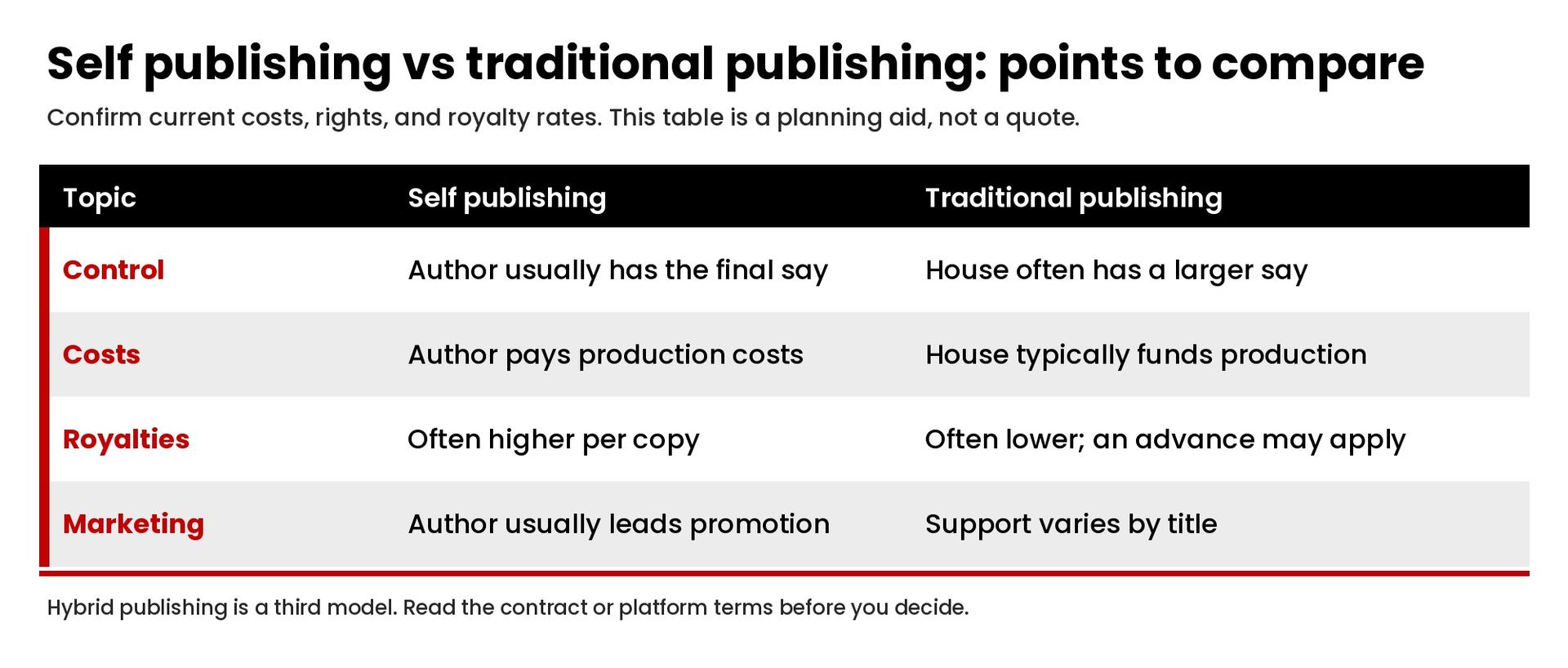
In return, many self published authors receive higher royalties on each book sold than they would under a typical trade contract, because they are not sharing revenue with a publishing house in the same way. Higher royalties are not the same as higher potential earnings. Earnings depend on book sales, price, discounts, and the cost of production and marketing. A higher rate on a book that does not sell can still leave the author behind.
Royalty Rates, Lower Royalties, and Advance Payment
Traditional publishing often offers lower royalty rates and lower royalties per copy, because the publisher has funded editing, design, printing, and distribution. Some traditionally published authors also receive an advance payment that is later recouped from future royalties. Advance sizes, royalty rates, and escalators differ by house, format, and negotiation. Confirm the current figures in the offer. Do not treat any percentage in a blog post as a substitute for the contract.
On both paths, potential earnings are a function of various factors: the size of the audience, the price, the publishing method, the quality of the book, and the marketing efforts behind it. An informed decision looks at cash timing (who pays first) as well as at royalty rates.
Publishing vs Distribution: Bookstores, Print on Demand, and a Wider Audience
Traditional publishers often have established relationships that can help a book reach brick and mortar bookstores, libraries, and trade channels. That access is one reason authors still pursue a publishing house. It is not automatic. Placement in stores depends on the list, the sales team, and the book itself.
Self publishing, especially through print on demand, makes it easier to keep a title available without a large print run. Print on demand services and e books can put a book into readers hands quickly. Reaching a wider audience is still a marketing problem, not only a printing problem. Independent authors can sell globally through retailers, but getting a self published title onto physical bookstore shelves can be harder and should be researched case by case.
A book stands out when the content, the cover art, and the marketing plan work together. Distribution is the pipe. It does not, by itself, make a book successful.
Marketing Strategies, Self Promotion, and Marketing Support
Marketing strategies differ by publishing method. In traditional publishing, a marketing department may provide marketing support around launch: metadata, some publicity, and trade outreach. The level of support varies, and many traditionally published authors still do self promotion. Do not assume a deal includes a large campaign.
In self publishing, marketing efforts usually sit with the author. Self promotion, a mailing list, retailer ads, and a clear description of who the book is for are part of the job. That can be an advantage for authors who already have an audience. It is a burden for authors who only wanted to write.
Market trends matter on both routes. A niche audience can be easier to serve through independent publishing. A title aimed at a wide trade audience may benefit from a house's sales network. Neither path removes the need for a plan.
The Publishing Journey: Literary Agents, a Publishing Deal, and Book Creation
The traditional publishing journey often starts with a query or a proposal, then literary agents, then submissions to editors, then a publishing deal, then a long production process. A first book may take time to find a home, or it may not find one. There is no reliable acceptance rate to quote here. If you need a query, follow the agent's current guidelines; this article is not a query-letter tutorial.
The self publishing journey starts when the manuscript is ready enough to produce. Book creation then includes professional editing, cover design, interior layout, metadata, and a release plan. The schedule can be shorter because the author sets it, but rushing a weak manuscript is still a poor publishing process. Quality takes time on either route.
Cover designers and a clear brief for cover art help a title look at home next to traditionally published books. Professional editing is equally important. Skipping those steps to save money often shows on the page.
How Self Published Authors and Traditionally Published Authors Can Decide
An informed decision starts with goals, not with slogans about which method is "real" publishing. Both self published authors and traditionally published authors are published authors if the book is properly produced and released.
Ask:
- Do I want more control, or do I want a house to run production?
- Can I fund the upfront costs of a professional self published edition?
- Am I prepared to lead marketing, or do I want a marketing department in the mix, knowing support still varies?
- Is bookstore distribution important to this project, and what can I realistically expect?
- Have I read the contract or the platform terms that will govern rights and royalty rates?
Many authors use more than one publishing route over a career: a traditionally published book in one line, a self published book in another. The publishing industry has room for both. The useful question is which publishing path fits this manuscript, this audience, and this season of work.
Writing, Production Quality, and What Makes a Book Successful
Writing is the part both routes still require. A publishing house will not usually repair a weak manuscript, and a self publishing platform will not either. The publishing path you choose cannot replace time spent on the draft, on professional editing, and on a cover that meets the standard of books already on the shelf.
A book successful in the sense that matters to most authors is one that reaches the readers it was written for, holds up next to traditionally published books, and can be stood behind in public. Sales help, but they are not the only measure. If the writing is unfinished, neither higher royalties nor a well-known imprint will hide it.
Production quality is part of that test. Hire professional editing and cover designers, proof the designed pages, and check metadata before release. Those steps are part of book creation whether you work with a publishing house or manage the process yourself.
Timing, E Books, and How a Book Is Sold
Timing is one of the practical differences in this publishing vs decision. Self publishing can move faster because the author sets the date, once the files are ready. Traditional publishing involves more hands and more calendar steps after a publishing deal is signed. There is no single timeline that applies to every title. Ask the publisher or your production team for a current schedule rather than relying on a generic range.
Format choices also differ. E books are central to many self published lists and are also issued by traditional publishers. Print on demand can keep a paperback available without a large inventory. How a book sold through retailers, stores, or direct channels should be planned early, because it affects price, royalties, and marketing strategies.
A Note on Hybrid and on Reading the Terms
Hybrid publishing is a third publishing method that combines elements of traditional and self publishing. The details vary by company. The Authors Guild has published guidance on what authors should review in hybrid contracts. Read any agreement for rights, fees, and royalty rates, and do not assume a hybrid offer is the same as a traditional acquisition or the same as independent self publishing. Our hybrid publishing guide is the next step if that model is under consideration.
Whatever the route, an informed decision is written down: costs, rights, approval of cover art, the marketing support you can actually expect, and how the book will be sold. If a term is vague, ask for it in writing.
Frequently Asked Questions
Is self publishing vs traditional publishing a once-and-for-all choice?
No. Authors can choose a different publishing method for a later book. The decision belongs to each project.
Do I need literary agents to self publish?
No. Literary agents are part of many traditional submissions. Self publishing does not require an agent, though some authors still use advisors for contracts or business questions.
Does traditional publishing mean I will not have to market?
No. Marketing support varies. Self promotion remains common for traditionally published books as well as for self published books.
Are higher royalties always better?
Not by themselves. Higher royalties on the self publishing side must be weighed against initial costs, marketing costs, and actual book sales. Lower royalty rates on the traditional side may come with an advance payment and production support. Compare the full picture.
Questions to Ask Before You Choose a Publishing Route
Before you sign a publishing deal or upload files to a platform, write down answers you can verify:
- Who owns which rights, in which territories and formats, and for how long?
- What are the current royalty rates for print, e books, and other editions, and is there an advance payment?
- What upfront costs or initial costs will I pay, and what do those fees cover?
- Who has the final say on the book's content, the title, and the cover design?
- What marketing support is included, and what marketing efforts will I still need to lead?
- How will the book be distributed to retailers and, if it matters to the project, to brick and mortar bookstores?
- What is the expected schedule, and what depends on my delivering a finished manuscript?
Bring those questions to a publisher, an agent, or a platform support team. The answers, not a generic comparison, should drive the informed decision.
Choose a Publishing Path with Clear Terms
Self publishing vs traditional publishing is a business choice as much as a creative one. Self publishing offers more control and, often, higher royalties, with high upfront costs and more responsibility for marketing and production. Traditional publishing offers a team, a possible advance payment, and established trade channels, with less control and, often, lower royalties. Confirm costs, rights, and royalty rates before you decide.
Masterly Publishing helps authors plan a professional path, including hybrid publishing when that model is the right fit. To discuss your manuscript, contact us or call (888) 209-4055.