




Foreword vs Preface: What Authors Should Include
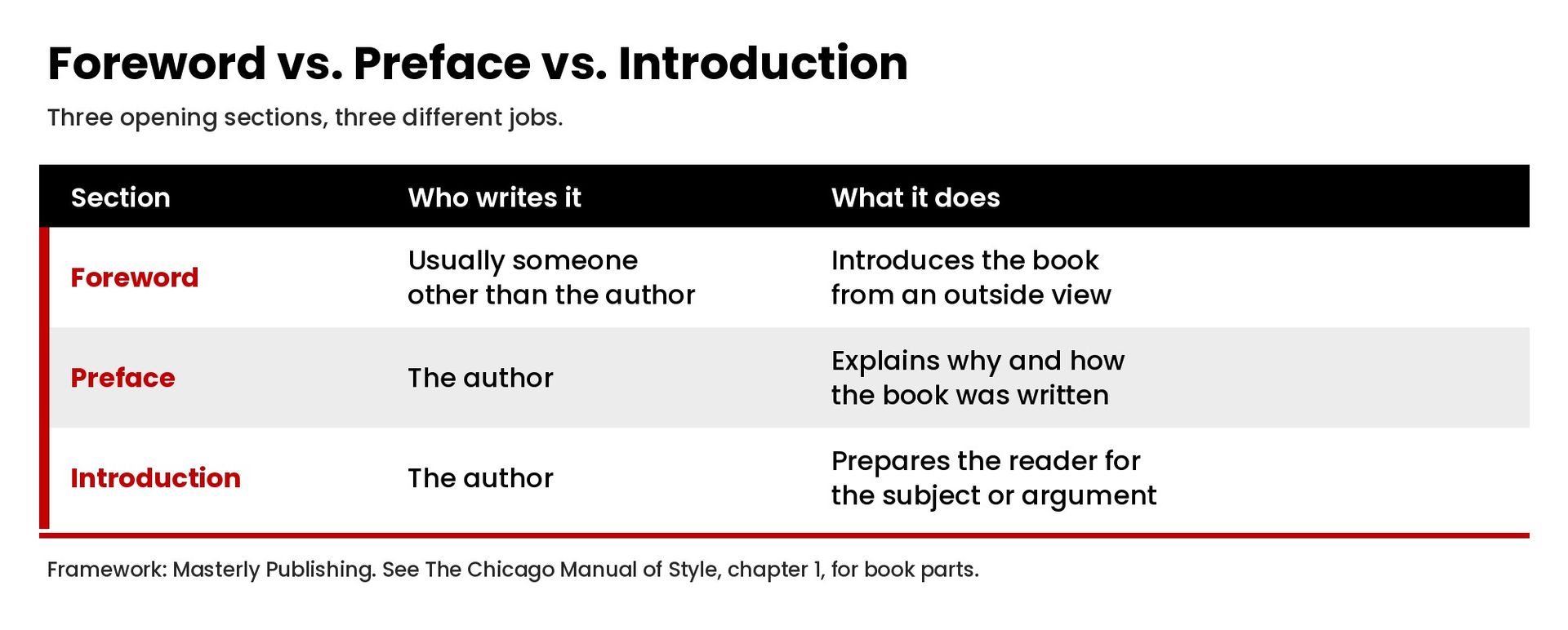
The difference between a foreword and a preface is who writes it and what it does. A foreword is usually written by someone other than the author to introduce and endorse the book. A preface is written by the author to explain why the book was written, its background, or how this edition came about. Neither replaces the book's introduction.
For nonfiction authors, choosing the right front matter is a small decision with a practical effect: readers should reach the main text with context, not repeat the same opening three times.

Foreword vs Preface: What Is the Difference?
A foreword gives the reader an outside perspective. The writer might explain why the subject matters, how the author approaches it, or what makes the work worth reading. The name attached to the foreword can add credibility, but only when the relationship to the book is genuine.
A preface is the author's own note about the work. It may describe the research that led to the book, the experience behind it, its intended audience, or changes made for a new edition. It generally sits outside the main argument.
The Chicago Manual of Style's overview of the parts of a book treats foreword, preface, and introduction as distinct elements. They should not be used as interchangeable labels for the same opening chapter.
What Belongs in a Foreword?
A useful foreword answers one reader question: why should I spend time with this book? It can connect the subject to a wider field, explain the author's contribution, and give a brief personal perspective from someone qualified to offer it.
Do not ask a prominent person for a generic endorsement and then expand it into several pages. Give the prospective writer the manuscript, a clear description of the audience, and a brief explaining the purpose of the foreword. Agree on a delivery date and the approval process before the book enters final production.
A foreword is usually written by someone other than the author. If the author writes an opening note in their own voice, preface is normally the more appropriate term. Also check the spelling: foreword , not forward . Forward is a direction. Foreword is the book element.
What Belongs in a Preface?
A preface explains the making of the book rather than teaching the subject itself. It is a suitable place to explain:
- What prompted the author to write the book.
- Which readers the author had in mind.
- What research or experience shaped the work.
- Why a revised edition changes or updates earlier content.
- How the book is organized, when that explanation helps the reader use it.
Keep it focused. A preface does not need to summarize every chapter, repeat the author's biography, or include all the acknowledgments. If a passage supplies essential knowledge for understanding the argument, it may belong in the introduction or main body instead.
For example, an author writing about workplace meetings could use a preface to explain how years of facilitating meetings led to the project. The introduction would explain the problem the book addresses and the approach readers will learn. The first chapter would begin the actual instruction.
How Is the Book's Introduction Different?
The book's introduction begins the relationship between the reader and the subject. It explains the promise, scope, central question, or argument of the work. In nonfiction books, readers may need that information to follow what comes next.
A simple test is to imagine removing the section. If readers would lose essential context for the argument, the material probably belongs in the introduction. If they would still understand the subject but know less about the author's writing journey, it is more likely preface material.
Our guide to how to write a book introduction focuses on that reader-facing opening. Keep the introduction distinct from personal background so the reader does not wait through several versions of the same explanation.
Do You Need Both a Foreword and a Preface?
No. Neither section is mandatory simply because other books include one. Some books need neither. Use both only when each performs a separate job.
A subject-matter expert might provide an outside foreword, while the author uses a short preface to explain why the current edition includes new research. That is a clear separation of purpose. By contrast, two sections that both say the book is important and describe the author's career add length without helping the reader.
Before adding front matter, write one sentence stating what each section must accomplish. If two sentences are substantially the same, combine, shorten, or remove one section.
Where Do They Go in the Book?
Foreword and preface usually appear in the front matter after the title page and other opening pages, before the main text. When both appear, the foreword commonly precedes the preface. Exact order depends on the publisher's style and the book's needs.
Pagination is a production decision. Many print books use lowercase Roman numerals for front matter and Arabic numerals for the main text. The introduction's placement and numbering can vary with its role. Do not make the manuscript's page numbers final before layout and the table of contents are settled.
See our book front matter guide for the wider sequence. A designer or production editor should apply the chosen style consistently across the whole publication.
What About a Prologue in Fiction?
A prologue is a different device. It is part of the storytelling, often presenting a scene, event, or viewpoint that prepares the reader for the story. It is not another term for a preface or a foreword.
If a section contains the main action of the narrative rather than a note about the writing, decide how it serves the story. Do not label it a preface simply because it comes before Chapter One.
A Practical Editing Test for the Opening Pages
Read the opening sections in order without jumping into the first chapter. Are you learning something different in each one? Mark repeated words, duplicated background, and claims that appear again in the rest of the book. A lot of repetition can hide inside an otherwise polished manuscript.
Create a short list of the purpose of each section. Next to every passage, identify which purpose it serves. If you cannot find a reason for a passage, do not fill space just to make the section look substantial. The number of pages is less important than the meaning they carry for an interested reader.
For updated editions, check that references to earlier editions are accurate and that the table of contents lists the final section titles. These tips apply to either type of nonfiction opening. The best way to keep the distinction clear is to decide what the reader needs before deciding how many sections to include.
Make the Opening Pages Earn Their Place
For every opening section, ask who is speaking, what the reader learns, and whether that information appears elsewhere. Remove repetition before the manuscript reaches copyediting and design. Contact Masterly Publishing if you need help organizing the manuscript and its production requirements.
Frequently Asked Questions
Can the author write the foreword?
A foreword is usually written by someone other than the author. The author's own explanation of the book's background is normally a preface.
Is a preface the same as an introduction?
No. A preface explains the background of the work. An introduction prepares the reader for the subject, argument, or promise of the book.
Which comes first, foreword or preface?
When both are included, the foreword commonly appears before the preface. Follow the publisher's style and the agreed front matter plan.
Is it foreword or forward?
Foreword is the correct spelling for the section of a book. Forward refers to a direction or movement.