

Pen Name: How Authors Choose One and What to Handle Before Publishing
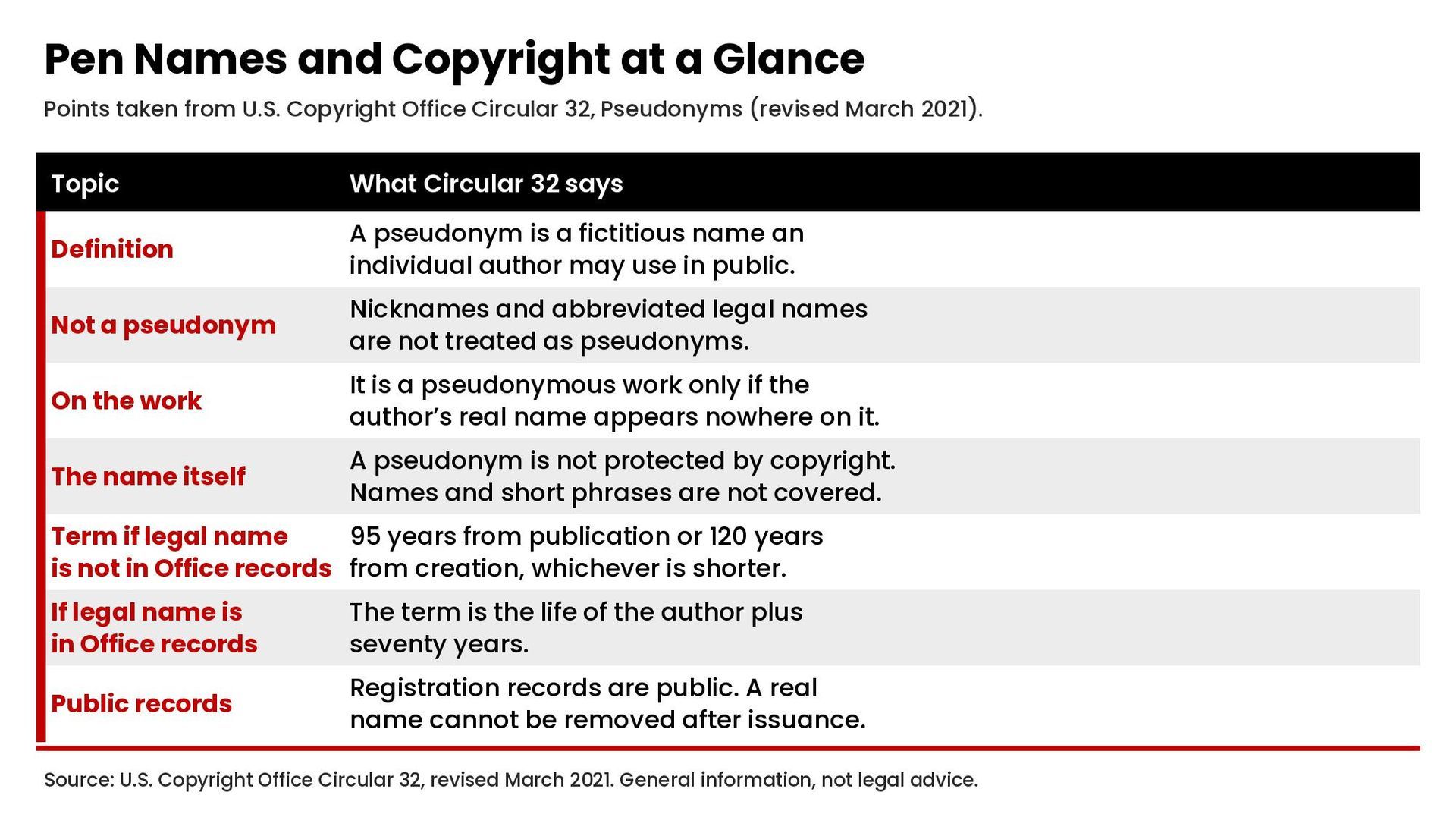
A pen name is a fictitious name an author uses in public instead of, or in addition to, a legal name. Writers also call it a nom de plume or a pseudonym. The U.S. Copyright Office, in Circular 32, Pseudonyms(revised March 2021), defines a pseudonym as "a fictitious name that an individual author may use to identify him or herself to the public."
Authors choose a pen name for many reasons: to separate a writing career from a private life or another job, to write in more than one genre, to keep a consistent byline, or simply because the made up name fits the work better than the name on a passport. In that sense, the name is a public label for authors writing in the publishing industry, not always a way to hide a true identity, and not always chosen for legal reasons. This article explains what a pen name is, how it differs from an abbreviated legal name, how authors often choose one, and what to handle before you publish, including copyright registration. It is general information, not legal, tax, or trademark advice, and it does not promise that any name can be used, registered, or protected.

What a Pen Name Is, and What It Is Not
A pen name and a pseudonym are the same idea: a fictitious name the author uses as a public identity. "Nom de plume" is the older phrase for the same practice. Are pen names still used today? Yes. Many authors still publish under a name that is not their legal name.
The Copyright Office draws a line that often surprises people. Nicknames and abbreviated forms of legal names are not considered pseudonyms. Circular 32 uses a well-known example: the British writer Joanne Rowling writes under "J.K. Rowling," which the Office treats as an abbreviated name, and "Robert Galbraith," which it treats as a pseudonym. This article does not state her private reasons for either choice. It only repeats the Office's example.
A work is a "pseudonymous work" under copyright law only when the author's real name does not appear anywhere on the work. Circular 32 is explicit: if the author's full name appears on the work or in the copyright notice, the work is not a pseudonymous work, even if a pseudonym also appears on the book or in the registration application. A pseudonymous work is also not an anonymous work, and a work made for hire cannot be registered as a pseudonymous work.
Another point from the same circular matters for brand thinking later: a pseudonym itself is not protected by copyright. "Copyright protection is not available for names or short phrases." If you want to look at name, title, or series-brand protection as a business matter, that is a separate question from copyright in the text, and it is covered later in this article without treating any filing as a certain result.
Why Authors Use a Pen Name
The purpose of a pseudonym is to give the public a name to attach to the work. Common practical reasons include:
- Keeping a private life, a day job, or another public role separate from the byline. A medical doctor, teacher, or executive, for instance, may prefer not to put a legal name on a novel.
- Writing in more than one genre, such as romance novels in one line and nonfiction in another, so readers and publishers can find the right shelf.
- Continuing a byline after a legal name change, or using a middle name the author already answers to in daily life, when that form is still an abbreviated legal name rather than a true pseudonym.
- Avoiding confusion with other authors or a famous person who already uses a similar name.
None of those reasons requires a pen name, and none of them is a legal requirement. Some authors are happy to use a real name. Others use a pen name for one book and a legal name for the next. The choice should fit the work, the audience, and the author's comfort with how public the real identity will be.
Historically, famous authors have used famous pen names. George Eliot (Mary Ann Evans), Mark Twain, Acton Bell, and Stephen King's Richard Bachman are commonly cited examples. Those names are part of literary history. They are not a template you have to copy, and this article does not reconstruct unsourced personal stories about why each writer chose the name.
How to Choose a Pen Name
There is no official list of cool pen names, and there is no official pen name generator that can clear a name for you. A generator can be a brainstorming aid if you are stuck, but it is not a search of living authors, domain names, or the marketplace. A few tips that actually help:
- Say the name out loud. If it is hard to pronounce, spell, or remember, readers will struggle with it too. The name should sound like a name, not a slogan. The Copyright Office will not accept a number or a symbol as a pseudonym, and it will not treat the name of a performing group as a pseudonym.
- Check whether other authors, a famous person, or an existing book series already use the same or a confusingly similar name. Search bookstore sites, library catalogs, and the web, not only a social app.
- Look at domain names and social media handles you may want for an author site or author bio. A name you cannot consistently use online will be harder to build an audience around.
- Stay aware of tone and genre. A name that fits a romance line may not fit a business book. That is a positioning choice, not a moral rule, and it does not require hiding your gender or inventing a false professional history.
- Write the name on a title page mockup next to the book title and see whether it belongs there. If it feels like a costume, keep working. Note that readers who already read books in that genre will be looking for a name they can find again, not a disguise.
You do not need a "perfect pen name." You need a name you can live with on the first book and on the books that may follow, and one that is not already closely identified with someone else.
What to Handle Before You Publish
Once you decide to use a pen name, a few practical items are worth handling before the book goes to press or to a retailer.
Contracts, payment, and your legal name. Publishers, platforms, and payment processors generally need the author's legal name for contracts, tax forms, and royalties, even when the public byline is a pseudonym. This article does not give tax or contract advice, and it does not describe a single required method. Talk with your publisher, a publishing attorney, or a qualified advisor about how your legal name and pen name should appear in an agreement. Friends can help you test whether a name sounds right; they cannot substitute for that review.
Copyright registration. You may register a pseudonymous work with the U.S. Copyright Office. Circular 32 encourages applicants to provide the author's real name in the application even if that name does not appear on the copies, because it creates a clear record of authorship and ownership and may affect the term of copyright. The Office also warns that registration records are open to the public. Do not disclose the author's real name or address in an application if the author does not wish to make that information public. "The Office will not remove the author's name from the registration record once a certificate of registration has been issued."
For works created on or after January 1, 1978, Circular 32 states that the copyright in a pseudonymous work expires 95 years from the year of publication or 120 years from the year of creation, whichever is shorter. If the legal name of the author is identified in the records of the Copyright Office, the term is the life of the author plus seventy years. Those dates in the application matter, so they should be accurate.
If you are registering a work as pseudonymous, Circular 32 says you are not required to provide the author's full name. You may check the box marked Pseudonymous and complete the Pseudonym field. Check that box only if the pseudonym, not the author's real name, appears on the copies, including the copyright notice. Do not check the anonymous box, and do not check the work-made-for-hire box. If you later want to add the author's real name to the record, the Office describes a supplementary registration in Circular 8.
The name as a brand. A pen name can become the public face of a writing career, a series, or a list of books. Copyright does not protect the name itself. If brand protection for a pen name, book title, or series name is part of your plan, see Masterly Publishing's page on trademark filing services for authors. That page is about brand protection, not a promise of availability or registration for any particular name.
The publishing plan. A pen name is one decision inside a larger plan: editing, design, metadata, and how the book will be issued. If you are still building that plan, our self-publishing consultant page explains how we approach the work before production spending begins.
Frequently Asked Questions
What is the name for a pen name? Are a pen name and a pseudonym the same?
Yes. Pen name, pseudonym, and nom de plume all refer to a fictitious name an author uses in public. "Pseudonym" is the term the Copyright Office uses in Circular 32.
What does using a pen name mean?
It means the name printed for the author on the work, and often in catalogs and publicity, is not the author's legal name. It does not, by itself, hide the author from a publisher, a bank, or the Copyright Office, and it does not automatically make the work a "pseudonymous work" under copyright law if the legal name also appears on the book.
Why did J.K. Rowling use pseudonyms? Why did she choose her abbreviated name?
Circular 32 uses J.K. Rowling as an example of an abbreviated legal name and Robert Galbraith as an example of a pseudonym. The circular does not state her reasons, and this article does not invent them.
Which famous authors use a pen name?
Many famous authors have. Circular 32 cites J.K. Rowling and Robert Galbraith. In literary history, Mary Ann Evans (George Eliot), Samuel Clemens (Mark Twain), the Bell pseudonyms, and Stephen King's Richard Bachman are also widely known examples. How many pseudonyms any living author has is a fact to confirm from that author's own statements, not a number to guess.
How do authors get paid if they use a pen name?
Payment and tax reporting typically run under the author's legal name, while the pen name appears as the public byline. The exact setup belongs in the publishing agreement and in advice from a qualified professional. This article cannot tell you how a particular platform or publisher will pay you.
How do you legally use a pen name? Are there rules for pen names?
There is no single license that grants the right to write under a fictitious name. What does exist are ordinary rules about contracts, truthful copyright applications, and, if you pursue it, brand protection. Circular 32 is the Copyright Office's overview of pseudonyms and registration. For the copyright law itself, the Office points to Title 17 of the United States Code. This article is not a substitute for advice about your situation.
How do you figure out your pen name?
Start with a name that sounds like a name, then search to see whether readers would confuse it with other authors or a famous person, and check whether you can use it consistently on a site, a domain, and social profiles. Skip the idea of a perfect pen name, and do not treat a pen name generator as clearance.
Talk Through Your Publishing Plan
A pen name is one decision among several that shape how a book meets readers. If you want help with editing, production, or a publishing plan that includes the byline you will use, contact Masterly Publishing or call (888) 209-4055 to talk through your next step.