


Line Editing Services: What a Line Editor Changes
Line editing services focus on the sentence and paragraph level of a manuscript: a line editor works through the writing line by line to improve clarity, word choice, rhythm, tone, and flow, so each sentence says what the author originally intended in the author's own voice. Line editing comes after developmental editing, which fixes structure and story, and before copy editing and proofreading, which correct grammar, spelling, punctuation, and consistency. If your book's structure is solid but the prose still feels flat, wordy, or uneven, a line edit is usually the right next step.
This guide explains what line editing means, how it differs from copy editing and developmental editing, examples of what a line editor changes, and how to tell whether your manuscript is ready for line editing services.

What Does Line Editing Mean?
Line editing, sometimes called stylistic editing or a type of substantive editing, is an edit of the language itself. A line editor reads every sentence and asks: is this clear, is it the best word, does it sound like the author, and does it move the reader forward?
A line editor typically works on:
- Word choice. Replacing vague, repeated, or weak words with precise ones.
- Sentence structure. Tightening wordy sentences, varying sentence length, and fixing awkward constructions.
- Clarity. Making sure each sentence and paragraph says what the author means.
- Voice and tone. Keeping the writing style consistent with the author's voice and the book's target audience.
- Rhythm and pacing. Adjusting how sentences and paragraphs flow so the reading experience matches the moment, quick in action, slower in reflection.
- Dialogue. In fiction, making dialogue sound natural and distinct for each character.
- Redundancy. Cutting repeated points, filler phrases, and unnecessary qualifiers.
- Transitions. Smoothing how one paragraph or idea leads to the next.
Line editing is creative work. The editor is not just correcting errors; they are helping the writing do its job better while keeping the author's voice intact.
Line Editing vs. Copy Editing vs. Developmental Editing
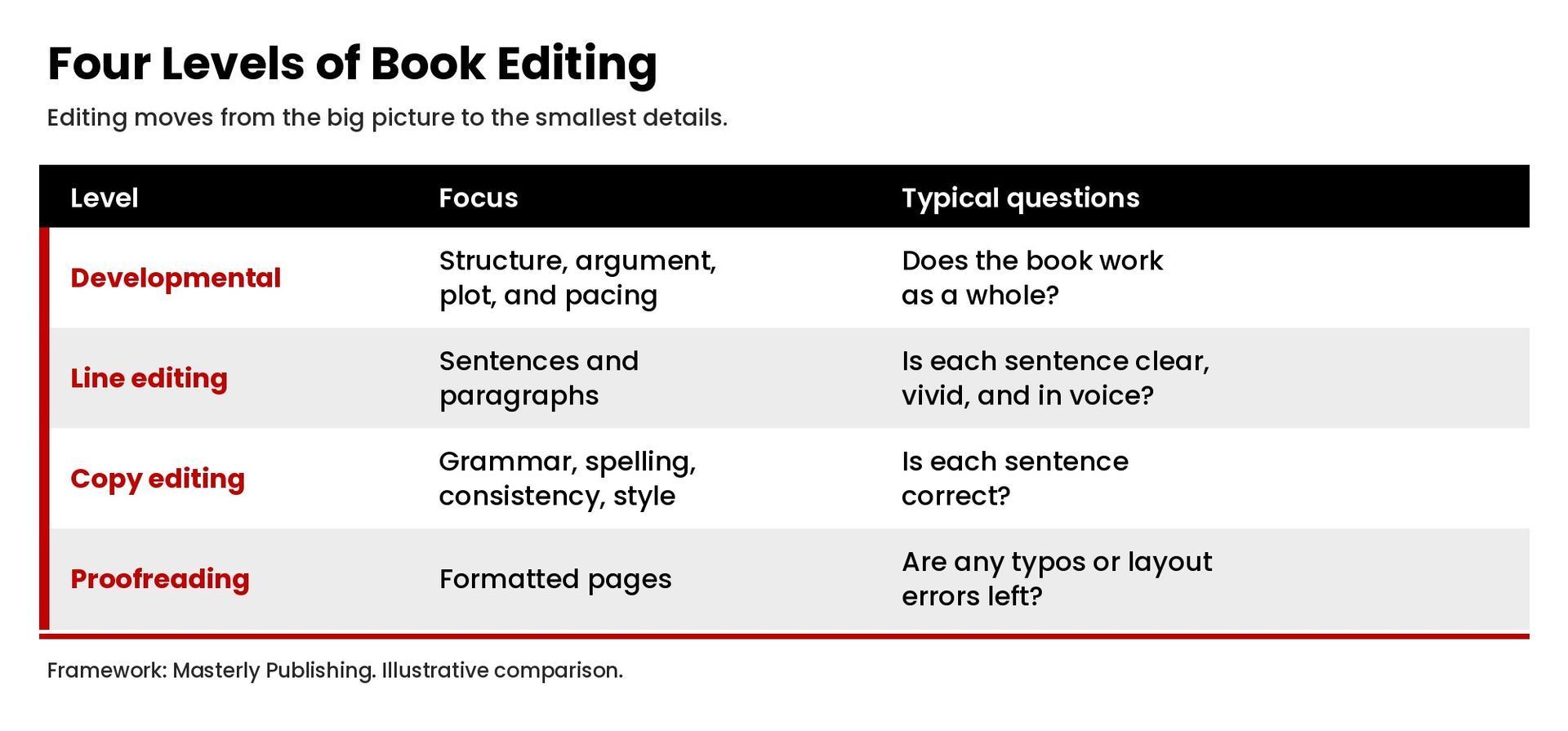
The editing process usually moves from big picture to small details. Understanding the difference helps you buy the right service at the right time.
Developmental editing
A developmental editor looks at the whole book: structure, argument, plot, character development, pacing across chapters, world building in fiction, and whether the book serves its target audience. Developmental editing happens first, because there is no point polishing sentences in a chapter that may be cut or rewritten. Our guide to developmental editing services explains why structure should be fixed before line editing begins.
Line editing
Line editing happens once the structure is stable. The line editor works at the sentence level and paragraph level to improve the prose itself. A line edit can involve significant rewriting suggestions, so authors should expect to review and respond to many changes.
Copy editing
Copy editing is a technical edit for correctness and consistency. A copy editor checks grammar, spelling, punctuation, word usage, verb tense, capitalization, numbers, and consistent style according to a style guide, and flags factual inconsistencies such as a character's eye color changing between chapters. Copy editing generally preserves sentences as written unless they contain errors. Our guide to manuscript editing services explains what should be fixed before copy editing.
Proofreading
Proofreading is the final step before publication, done on the formatted pages. A proofreader catches remaining typos, formatting errors, and layout problems. It is not a substitute for line editing or copy editing. See our guide to book proofreading services.
What Is Line Editing vs. Copyediting?
This is the most common question authors ask. The simplest way to think about it:
- Line editing asks whether a sentence is effective. Is it clear, vivid, and in the right voice?
- Copy editing asks whether a sentence is correct. Is the grammar, spelling, punctuation, and style consistent and accurate?
A line editor might rewrite a sentence to make it stronger. A copy editor would usually leave that sentence alone unless it contained an error. Some editors offer a combined line and copy edit, but each pass requires a different focus, and many professional editors recommend doing them separately for longer books.
Examples of Line Editing
Here are a few examples of the kinds of changes a line editor might suggest. These are illustrations written for this guide, not edits from a client manuscript.
Wordiness.
- Before: At this point in time, she was in the process of starting to realize that he was not going to come back.
- After: She was beginning to realize he wasn't coming back.
Weak verbs.
- Before: The wind was very strong and made the door move back and forth.
- After: The wind slammed the door back and forth.
Clarity.
- Before: The policy, which was introduced by the board after the review that the committee had requested, changed things.
- After: After the committee requested a review, the board introduced a policy that changed how approvals worked.
Voice consistency. In a casual, conversational nonfiction book, a line editor might flag a paragraph that suddenly shifts into formal, academic language and suggest wording that matches the rest of the chapter.
Repetition. If three sentences in a paragraph start with the same word, or a favorite phrase appears on every page, the line editor will point it out and suggest alternatives.
In each case, the goal is not to make the writing sound like the editor. It is to make the author's writing sound like the best version of itself.
Is Your Manuscript Ready for a Line Edit?
Line editing is most valuable when the book's structure is settled. Before you hire a line editor, ask:
- Is the structure final? If you still plan to move, cut, or add chapters, start with developmental editing or a manuscript evaluation.
- Have you revised it yourself? Most authors benefit from at least one full self revision before paying for a line edit.
- Do readers get lost or bored at the sentence level? If beta readers say the story works but the writing feels clunky or slow, a line edit addresses that.
- Is your voice inconsistent? Books written over long periods often shift in tone. A line editor can help bring it together.
If the answer to the first question is no, a line edit is likely premature. Line editing an unstable manuscript means paying to polish sentences that may not survive the next draft.
What to Expect From Line Editing Services
Every professional editor works a little differently, but most line editing services include:
- A sample edit or consultation, so you can see the editor's approach and decide if it fits your voice.
- Tracked changes and comments in your document, so you can accept, reject, or adjust each suggestion.
- Queries where the editor is unsure of your meaning and needs you to decide.
- A summary note describing patterns the editor noticed, such as overused words or recurring sentence structures, so you can apply the lessons to future writing and your next novel or book.
- A clear scope, including whether the edit covers the entire manuscript, which style guide is used, and whether a second pass is included.
Expect a line edit to take more time than proofreading. The editor is reading closely and making decisions on nearly every page.
How Much Does a Line Edit Cost?
Line editing cost depends on the length of the manuscript, the condition of the writing, the genre, the turnaround time, and the editor's experience. Most editors quote by word count or by project after reviewing a sample. The most reliable way to get an accurate number is to request a sample edit and a quote based on your actual manuscript. Our book editing services page explains how we scope editing projects.
Can AI Replace a Line Editor?
AI tools can flag grammar issues and suggest alternative phrasing, but line editing depends on judgment: understanding what the author intended, how the voice should sound, what the target audience expects, and when breaking a rule serves the story. A professional editor brings editorial skills and context that automated tools do not. Many authors use software for a first self edit and a human line editor for the work that requires judgment.
Choosing a Line Editor
When you evaluate line editing services, look for:
- Experience in your genre. Fiction, memoir, business, and academic writing each have different conventions.
- A sample edit. This is the best way to see whether the editor improves your writing without overwriting your voice.
- Clear communication. You should understand how changes will be marked and how questions will be handled.
- A defined scope and timeline. Know what is included and when you will receive the edit.
If you are not sure which type of editing your book needs, start with an assessment. Our author coaching and book publishing services pages explain how editing fits into the path from manuscript to finished book.
Frequently Asked Questions
What does line editing mean?
Line editing is an edit of a manuscript at the sentence and paragraph level, focused on clarity, word choice, flow, tone, and voice. It improves how the writing reads, not just whether it is correct.
What is line editing vs. copyediting?
Line editing improves the effectiveness and style of each sentence. Copyediting checks correctness and consistency, such as grammar, spelling, punctuation, verb tense, and style guide rules.
Do I need a line edit if I have a developmental edit?
Often, yes. A developmental edit fixes structure and story, but it does not polish the prose. Many books need a line edit after developmental revisions, then a copy edit and proofreading.
Can line editing and copy editing be done together?
Some editors offer a combined edit, but each requires different attention. For longer or more complex books, separate passes usually catch more.
How long does a line edit take?
It depends on the length of the manuscript, the condition of the writing, and the editor's schedule. Ask for a timeline when you request a quote.
Get a Line Edit That Keeps Your Voice
Line editing services make your writing clearer, stronger, and more consistent while keeping it yours. Fix structure first, revise on your own, and then work with a line editor who understands your genre and audience. For authors in Texas, see our Dallas book editing services page, or contact Masterly Publishing to request a sample edit.