



What Is an Epilogue? Purpose, Examples, and How to Write One
An epilogue is a short section at the end of a book, placed after the final chapter, that shows what happens after the main story ends. It often jumps forward in time to reveal the characters futures and how the story changed the characters lives, tie up loose ends, or offer closure, and it gives readers a last look at the world of the story before they close the book.
So what is an epilogue for, and does your book need one? This guide explains the purpose of an epilogue, how it differs from a prologue, afterword, and conclusion, well-known examples, and how to write an epilogue that leaves a lasting impression instead of detracting from the ending.

What Is an Epilogue in a Book?
The word "epilogue" comes from the Greek epilogos , meaning a concluding word. In a literary work, an epilogue is a closing section that sits outside the main narrative. The climax and resolution happen in the last chapter; the epilogue comes after, often set weeks, months, or years later.
In literature, epilogues are most common in novels, especially fantasy, romance, and series fiction, but they also appear in plays, films, and some nonfiction. In nonfiction, a similar closing section usually takes the form of an afterword or a conclusion.
An epilogue is part of the back matter of a book. For the full order of opening and closing pages, see our guide to book front matter.
What Is the Purpose of an Epilogue?
A strong epilogue serves one or more clear purposes:
- Offering closure. An epilogue can provide closure on the main character's journey and answer lingering questions the final chapter left open.
- Showing the characters' futures. It can reveal how the story's events changed the characters' lives, giving readers a sense of what happened next.
- Reinforcing the theme. An epilogue can underline the story's moral or central theme through a brief reflection.
- Setting up a sequel. In a series, an epilogue can hint at future events or new conflicts and invite readers into the next book.
- Adding context. Some epilogues offer additional information, such as a historical frame, that changes how readers understand the story.
An epilogue should never be required to understand the main story. If readers cannot follow the plot without it, that material belongs in the final chapter.
Epilogue vs. Prologue vs. Afterword vs. Conclusion
These closing and opening sections are easy to confuse. Here is how they compare:
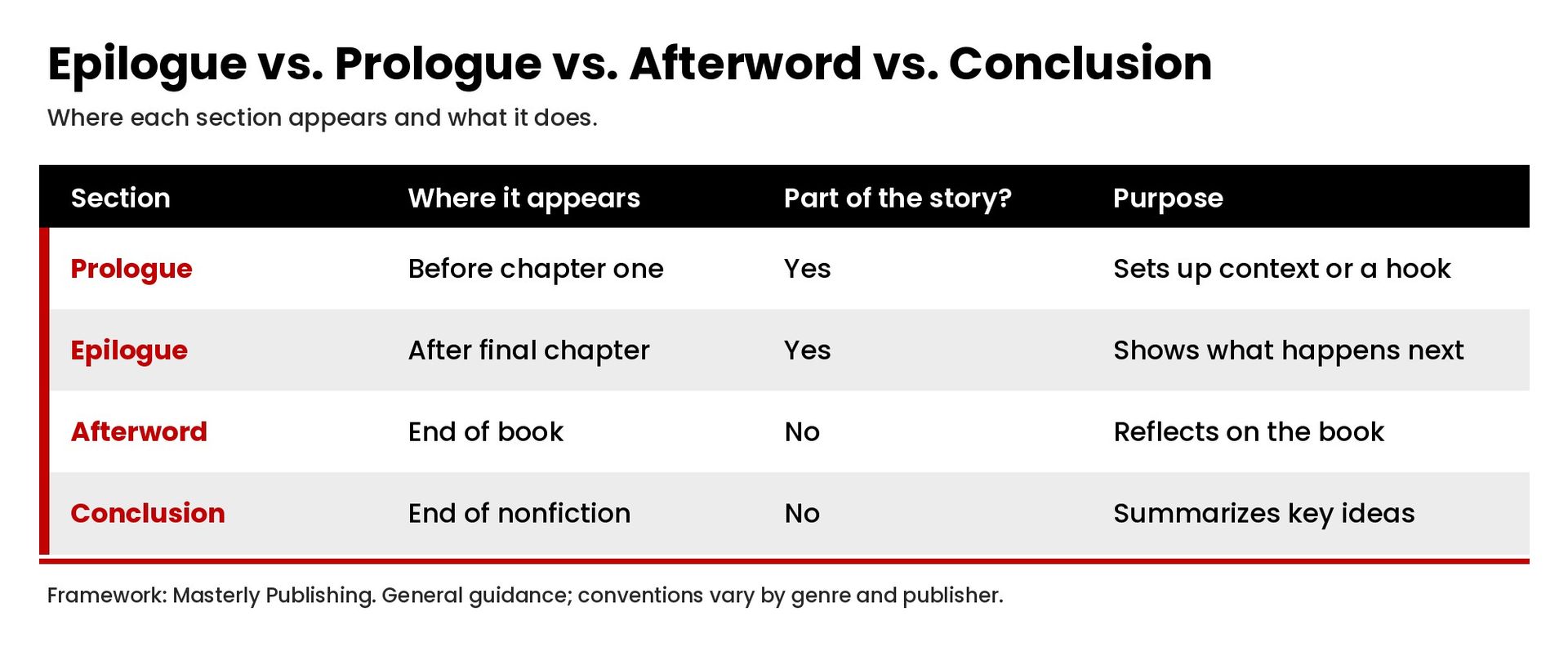
- Prologue. The opposite of an epilogue. A prologue appears at the beginning of a book, before chapter one, and sets up context, history, or a hook for the main narrative.
- Epilogue. Appears at the end, after the final chapter, and is part of the story. It is usually written in the same voice as the novel.
- Afterword. Appears at the end but sits outside the story. The author or another person reflects on how the book was written, its history, or its reception.
- Conclusion. Common in nonfiction. It summarizes the book's arguments and key insights rather than continuing a narrative.
If you are also deciding how to open your book, our guide to foreword vs. preface explains the opening pages that sit outside the story.
What Are Examples of Epilogues in Literature?
Two well-known examples show how differently epilogues can work:
- Harry Potter and the Deathly Hallows (J.K. Rowling). The epilogue, titled "Nineteen Years Later," jumps forward to show Harry and his friends seeing their own children off to Hogwarts. It offers closure on the main characters' futures after the series' final battle ( Wikipedia).
- The Handmaid's Tale (Margaret Atwood). The novel ends with a section called "Historical Notes," set far in the future at an academic conference discussing the narrator's account. It reframes the entire story and adds historical context rather than tying up loose ends neatly ( Wikipedia).
The first epilogue answers questions; the second raises new ones. Both work because they serve the book's theme.
How Are Epilogues Used in Plays, Movies, and Other Genres?
The epilogue is one of the oldest storytelling devices in literature. In a play, an epilogue is often a short speech delivered directly to the audience after the action ends. Shakespeare's The Tempest , for example, closes with Prospero addressing the audience and asking them to set him free with their applause ( Wikipedia).
Movies use the same idea, often with a final scene or on-screen text that tells the audience what happened to the characters later. In novels, the epilogue serves a similar purpose across genres:
- Fantasy and science fiction. Epilogues often highlight the wider implications of the story for its world, or hint at the next conflict.
- Romance. A short epilogue can show the couple's future and reinforce the happy ending readers expect.
- Literary fiction. Epilogues may focus on character development and reflection, exploring how the events changed someone, rather than suggesting what comes next.
- Historical fiction. An epilogue can connect the story to reality by explaining what happened to real people or places.
Whatever the genre, the epilogue should support the book's central message.
Does Your Book Need an Epilogue?
Not every story needs an epilogue. Many great novels end on the final chapter, and an unnecessary epilogue can weaken a strong ending. Ask yourself these questions:
- Is there something readers truly need to know after the climax? If the final chapter already provides closure, an epilogue may detract from it.
- Does the epilogue add meaning? It should deepen the theme or the reader's understanding, not repeat what they already know.
- Is there a time jump? Epilogues work best when they show events that could not fit naturally in the last chapter.
- Is this part of a series? An epilogue can bridge books, but avoid a cliffhanger that makes the current book feel unfinished.
If you are unsure, ask beta readers to read the book with and without the epilogue. Our guide to beta readers explains how to get useful feedback.
How Do You Write an Epilogue?
Use these steps to write an epilogue that strengthens your novel.
1. Know its purpose
Decide what the epilogue needs to do: provide closure, reveal the characters' futures, reinforce a theme, or hint at a sequel. A clear purpose keeps it focused.
2. Keep it concise
Most epilogues run from a page or two to a short chapter. Readers have just finished the climax, so keep the epilogue brief and purposeful.
3. Maintain consistency
Match the story's tone, point of view, and style. An epilogue that suddenly shifts voice can feel like it belongs to a different book.
4. Avoid introducing major new plot
Do not introduce new conflicts you cannot resolve. Avoid introducing new main events, characters, or subplots that the story cannot address. A small hint of the future is fine; an entirely new storyline is not.
5. Show, do not summarize
Rather than listing what happened to each character, show a single scene that reveals how their lives changed. A strong scene creates a lasting impression.
6. Revisit it during editing
Read the epilogue again after revising the final chapter. If the last chapter now resolves everything, consider cutting the epilogue. A developmental editor can help you decide; see our developmental editing services.
What Mistakes Should Writers Avoid in an Epilogue?
- Restating the ending. Repeating what readers just read adds nothing.
- Tying every thread too neatly. Some unanswered questions can be a strength.
- Undercutting the climax. An epilogue that reverses the ending can leave readers feeling cheated.
- Making it too long. A long epilogue starts to feel like an extra chapter.
- Using it to fix plot problems. If the main story has gaps, fix them in the manuscript, not in the epilogue.
Frequently Asked Questions
What is the difference between an epilogue and a final chapter?
The final chapter completes the main narrative, including its climax and resolution. An epilogue comes after and usually shows events at a different time or from a wider view.
How long should an epilogue be?
Most epilogues are short, from a page or two to a brief chapter. Keep it concise and focused on one purpose.
Can nonfiction books have an epilogue?
Yes. Memoirs and narrative nonfiction sometimes use an epilogue to update readers on what happened after the events of the book. Other nonfiction more often uses a conclusion or afterword.
Is an epilogue the same as an afterword?
No. An epilogue is part of the story, while an afterword sits outside the story and usually reflects on the book itself.
Get Expert Help With Your Ending
Writing a strong ending is one of the hardest parts of writing a literary work. The ending is the last thing readers remember, and an epilogue can strengthen or weaken it. If you want a professional view of your manuscript's structure, from the opening chapter to the last page, contact Masterly Publishing to talk through editing and publishing support.