

Author Bio What Belongs in a Professional Bio for a Book, Website, and Media Kit
You can spend months or years developing a book and still reach publication with an author bio that feels like an afterthought. An author bio is a professional description of the person who wrote the book or other work, built from selected details that fit the work, the audience, and where the bio will appear.
The problem is rarely a lack of accomplishments. Authors, executives, educators, speakers, experts, and other professionals often have years of experience, credentials, leadership roles, publications, and professional work. The challenge is deciding which details belong beside the book, which belong elsewhere, and how those details should be presented to readers.
A résumé is not an author biography. Neither is a list of every professional accomplishment.
Your author bio should give readers relevant context about who you are, why your background connects with the work, and where you fit within the larger subject. It should also support the book’s positioning, strengthen professional credibility, and stay consistent with the broader platform around it, whether that includes your website, media materials, speaking engagements, or other public-facing content.
Masterly Publishing helps authors approach these pieces as connected parts of professional publishing rather than unrelated documents created at the end of the project. In this article, we focus on what belongs in a professional author bio, how to tailor it for different platforms, and how to keep it relevant to both the book and the author’s overall professional identity.
Your Author Bio Has to Do More Than List Credentials or Write in Third Person
Many professional authors have extensive backgrounds.
Including everything can make the biography less useful.
A reader interested in a leadership book may need to understand the author's relevant executive experience. Someone reading a book by an educator may benefit from knowing the author's connection to the subject. An expert writing about a professional field may have credentials that provide important context.
The purpose is relevance.
A professional author biography should help the intended audience understand the relationship between the person and the work without becoming a complete employment history.
That requires editorial judgment.
A Professional Author Biography Supports the Book's Positioning
The book and biography should make sense together.
Imagine an executive writing about organizational leadership while the biography focuses almost entirely on unrelated personal interests. Or an educator publishing on a specialized subject while the most relevant professional experience appears at the end.
Those details may all be true.
But their order and emphasis influence how readers understand the author.
A professional book author bio should support the positioning of the book by emphasizing truthful information relevant to its subject and audience.
That does not mean exaggerating expertise or manufacturing authority. It means selecting and organizing accurate information so readers can understand why the author's background matters to this particular work.
The Best Bio Is Not Necessarily the Longest
Length should follow purpose.
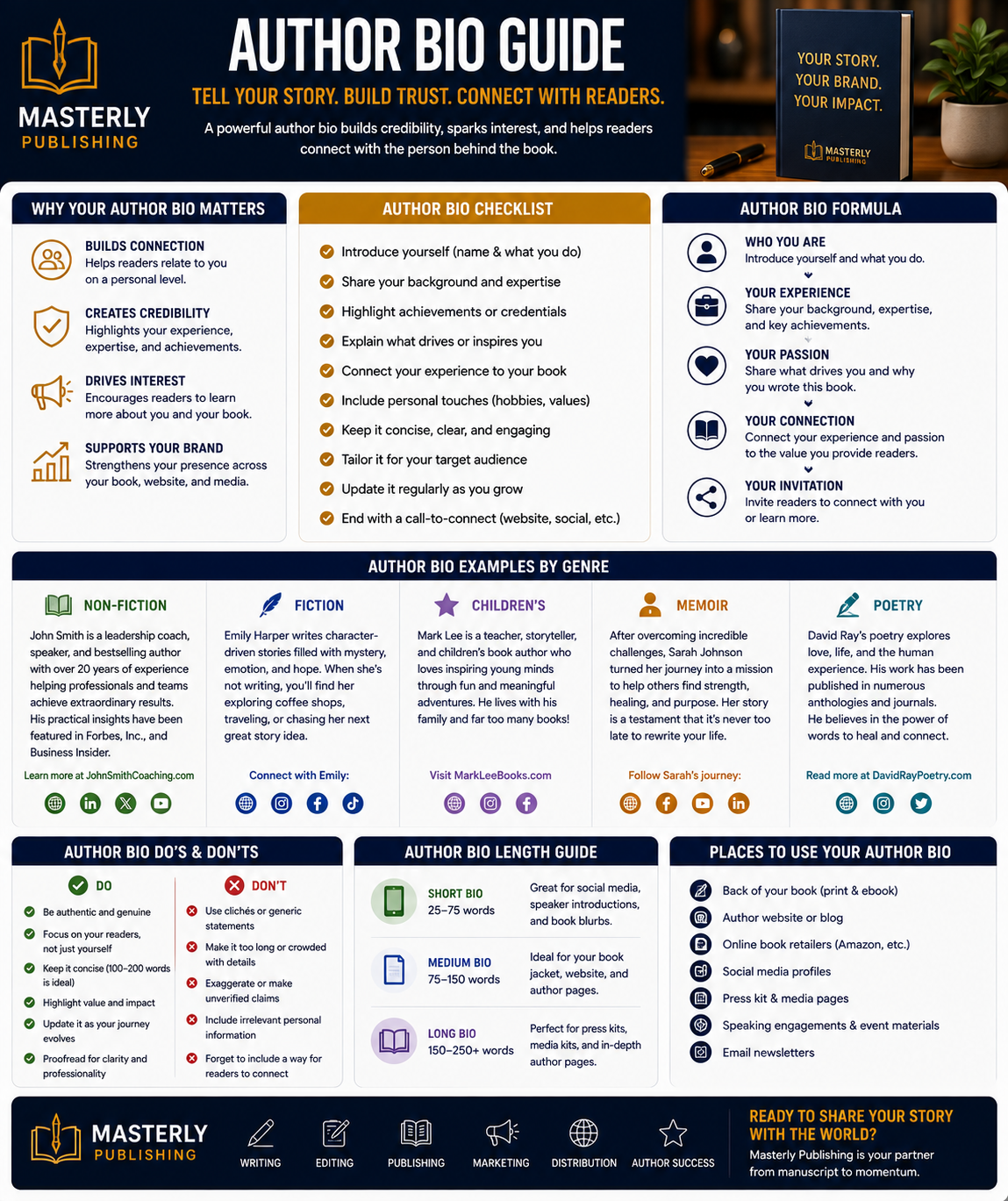
Some placements provide room for a fuller biography, including a long bio. Others need a much shorter version that delivers a quick overview in fewer words.
Trying to use one long biography everywhere can create problems. A book jacket, website, media document, event introduction, and other professional materials may have different space and context requirements. Many online bios work best at about 50 to 100 words.
That is why authors should create multiple versions of their author bio rather than rely on a single paragraph.
The central facts remain consistent while the presentation can be adapted to the setting.
Author Bio Examples Can Help, but They Cannot Define Your Positioning
Looking at author bio examples can show how other writers organize information, which can help when you write an author bio as long as you do not copy them.
They should not become templates for copying someone else's professional identity.
One author may lead with academic credentials. Another may emphasize executive leadership. A writer of fiction may focus on previous publications or novels. A professional speaker may need to connect a book with a larger area of expertise.
The right emphasis depends on the person, book, and audience.
Generic author bio examples cannot determine which accomplishments are most relevant to your positioning.
That decision requires understanding the author behind the information. More examples are only useful when they clarify how different backgrounds or genres shape emphasis, not when they become templates.
A Book Author Bio Should Fit the Reader's Context
The biography appearing with a book serves a specific audience.
Those readers have encountered you through the work.
Your book author bio should therefore make sense in relation to what they have just read or are considering reading.
For non-fiction authors, this often means identifying relevant experience, professional roles, education, or other accurate qualifications when they meaningfully support the subject.
Non fiction authors often need stronger subject-matter qualifications than fiction writers.
For authors in other genres, different information may be appropriate.
The key is avoiding the temptation to make the bio carry every detail about your life and career.
This version is usually written in the third person.
It should introduce the author behind this book, with only relevant personal context, such as hobbies or where you live, when that supports the presentation.
Your Author Website May Need More Room for Your Professional Story
An author website can provide more space than a book jacket or retailer description, and it may be the right place for a long bio alongside a shorter version.
That does not mean the website biography should become an unedited résumé.
A longer biography can provide context around the author's professional path, work, publications, expertise, or other relevant background while still maintaining a clear relationship to the platform.
The website may also serve several audiences. It can also include a blog, course information, or other platform content when relevant.
Readers may visit after discovering the book. Journalists may be researching the author. Event organizers may want to understand speaking experience. Potential professional contacts may arrive because of the author's larger work.
The biography should support those visitors without trying to tell everyone everything at once, since some pages call for a quick overview while others need a fuller version.
A Media Bio Needs to Be Easy to Understand
A media bio serves another purpose.
Someone preparing an interview, article, podcast, event, press releases, or other media opportunity may need a concise understanding of the author and the relevance of the author's work.
That information should be accurate and easy to use. It is often a quick overview prepared for media materials.
Overly promotional language can make a professional biography less credible. Dense lists of titles and credentials can make the most relevant details harder to identify.
A strong media presentation focuses on useful context.
The author, book, expertise, and appropriate professional background should connect clearly. In some media settings, it also helps to include a simple call to action that directs people to the author website or contact point.
Consistency Across Public Materials Protects Clarity
Problems can arise when an author has several conflicting biographies in circulation.
The book contains one description. The website uses another. An old speaker page may reference outdated published work, miss new publication details, or leave out recent achievements. Media materials introduce the author differently again.
Minor differences in length are normal.
Differences in fundamental positioning can create confusion. Each version should be updated whenever the author has a new publication or notable achievement.
A coordinated publishing and author-platform strategy can establish core information that remains consistent while allowing each version to serve its particular setting.
A Speaker Bio Should Introduce the Person the Audience Is About to Hear
A speaker bio is not automatically the same as a book biography.
An event organizer may need language that introduces the speaker in relation to a particular presentation, audience, or subject.
Relevant credentials and the book may belong in that introduction, but the emphasis should fit the speaking context.
For authors who also speak professionally, the relationship between the book and speaking platform deserves attention.
The book may establish or deepen a subject the author discusses publicly. Speaking may introduce new audiences to the book.
When the positioning is aligned, these activities can reinforce a coherent professional identity.
Professional Bios Should Be Specific About Previous Publications Without Becoming Promotional Claims
Credibility comes from accurate information.
A professional biography does not need exaggerated adjectives to make an author sound accomplished.
Specific roles, relevant experience, appropriate credentials, publications, and other verifiable information can often communicate more than broad claims about being a leading or renowned authority.
This matters particularly for experts and executives.
The biography may be used by publishers, agents, event organizers, journalists, podcast hosts, readers, and professional contacts.
Unsupported claims can weaken the professionalism the bio is supposed to establish.
Masterly Publishing approaches author positioning with the book and the author's actual background in mind. A well-crafted bio can also help potential readers understand why the book is worth their attention.
Your Author Bio Should Match the Voice of Your Platform
Professional does not have to mean impersonal.
An author bio can still reflect the person behind the credentials.
Most formal bios are written in the third person, though some platform-specific uses may allow first person.
The appropriate amount of personality depends on the author, genre, audience, and platform.
An executive publishing a business book may need a different tone from an educator writing for parents or an author publishing a personal work.
The important point is consistency.
If the book and website communicate a thoughtful, professional identity while the biography suddenly becomes overly casual or promotional, the platform can feel disconnected, while social media profiles may support a more direct, personal tone.
Voice is part of positioning, and even humor can work when it fits the author’s established voice and audience expectations.
The Bio Should Be Planned Before the Publishing Project Is Finished
Authors often wait until late in the publishing process to write an author bio.
By then, the bio may be needed in several places at once. Planning early makes it easier to prepare a one-sentence version and longer versions for different uses.
Considering it earlier gives the author time to review the information, confirm accuracy, identify what matters most, and determine whether different versions are needed.
It can also reveal broader platform questions.
If the author struggles to explain how professional experience connects to the book, the issue may involve positioning rather than wording alone.
Addressing that before publication can improve consistency across other author materials and help present the author in the best light without exaggeration.
The Author Bio Is Part of the Author Platform
Your public identity extends beyond a paragraph.
The author bio, website, book, professional photographs, media materials, speaking presence, social media profiles, and other appropriate channels can work together as parts of an author platform.
Each piece has a different function. Some versions may be used as a post byline, website page summary, or media snippet depending on the channel.
Together, they help people understand who the author is and how the book relates to that person's larger work.
This becomes especially important for executives, educators, experts, and speakers whose books may support a professional platform extending well beyond publication.
The biography should make sense inside that larger picture.
A Strong Bio Can Make Media Preparation Easier
When someone invites an author to participate in an interview or event, basic information should not have to be reconstructed every time.
A prepared media bio and related author materials can provide a consistent foundation.
The host or organizer can understand the author's background and relationship to the subject more easily.
The author also has an established source of approved information rather than repeatedly writing new descriptions under deadline.
That preparation can become part of the larger publishing and launch process.
Masterly Publishing Helps Align the Book and the Author Behind It
Publishing a professional book involves more than preparing manuscript pages.
The person behind the book also needs to be presented clearly.
Masterly Publishing works with authors, experts, executives, educators, and other professionals preparing books for publication. As part of the appropriate publishing project, the conversation can consider how the author's public positioning relates to the book and larger platform.
That means looking beyond whether an author biography is grammatically correct.
The more important questions involve what the audience needs to know, which information is relevant, how the biography connects with the book, and how the author's public materials work together.
The objective is a professional identity grounded in accurate information.
Frequently Asked Questions About an Author Bio
What is an author bio?
An author bio is a professional description of the person who wrote a book or other work, giving a quick overview rather than a full life history. It typically presents selected background information relevant to the author, work, audience, and placement. It tells readers who wrote the work, why that background matters, and how the author relates to the subject.
What belongs in a professional author bio for a self published author?
The appropriate content depends on the author and book. It may include relevant professional experience, education, credentials, previous publications, roles, or other accurate background information; important elements can also include selected achievements or an award when they are relevant to the book and audience, and authors should mention only details that support credibility and fit the context.
Is an author bio the same as an author biography?
The terms author bio and author biography are often used for similar material. A biography can vary in length depending on where it will appear, from a single sentence to a longer format based on placement and available space.
What is a book author bio?
A book author bio is the version of the author's biography prepared for use in connection with a particular book. It is usually concise, written in third person, and tailored to the audience for that specific title.
Should I copy the structure of author bio examples?
Author bio examples can help cover key do’s and don’ts, but each example should support rather than override your own background, book, audience, and professional positioning. One approach may fit a debut author, while another suits an established published author.
What is a media bio?
A media bio provides relevant professional information about an author for interviews, media appearances, press materials, or similar uses. It is also often reused in press releases and related promotional materials, so clarity and consistency matter.
Is a speaker bio different from an author bio?
It can be. A speaker bio may emphasize information relevant to the event, presentation, or audience, while a book biography focuses more directly on the author's relationship to the work.
Do I need more than one version of my biography?
Different settings may require different lengths or emphasis, so authors often need multiple versions, such as a brief website version, a long bio, and a media-ready version. The underlying facts and professional positioning should remain consistent, even when those versions are adapted for social media profiles, the author website, and press materials.
Should an author bio include personal information?
It can when that information is appropriate to the author, book, audience, and desired public presentation. For example, an author bio might mention where the author lives, a few hobbies, or family details such as a husband when those details are relevant. Personal details do not need to be included simply because other authors use them, and they should support connection with readers rather than distract from the book.
Can Masterly Publishing help align my biography with my book?
Masterly Publishing provides professional publishing support. Authors can contact the team to discuss their book, author platform, publishing needs, and public positioning.
Ask Masterly Publishing to Help Align Your Book, Author Platform, and Public Positioning
Your author bio should not feel like a résumé squeezed onto a book page.
It should present the relevant person behind the work clearly and professionally while fitting into a larger author platform.
Masterly Publishing can help you consider how your book, author biography, website presence, media materials, and professional positioning work together as you prepare for publication.
Call:
(888) 209-4055
Website:
masterlypublishing.com