


Book Dedication: How to Write One That Fits the Tone of the Book
A book dedication is a brief personal tribute placed near the beginning of a book to honor someone important to the writer, while a book blurb is the short marketing copy that explains the book to readers. If you are preparing a manuscript and its publishing materials, both need to do different jobs well: the dedication adds a personal note, and the blurb builds interest without giving too much away.
That distinction matters to fiction and nonfiction authors because blurbs, dedications, and other front- and back-matter shape reader expectations, signal the book’s promise, and contribute to a professional, consistent publishing package. Fiction authors may reveal too much of the plot while trying to explain the story. Nonfiction authors may summarize every chapter instead of showing readers why the subject matters. Other authors create a description so vague that a potential reader still does not understand what the book offers.
A professional book blurb has a different job from the manuscript itself. It needs to communicate enough about the book to create interest without trying to reproduce everything inside it. This guide explains how to write book blurbs and dedications, how blurbs differ from synopses and book descriptions, how to approach blurb writing for fiction and nonfiction, and how to keep your marketing copy aligned across your publishing materials.
That copy may become part of your back cover, retailer listing, author website, promotional materials, or broader publishing presentation. Getting it right therefore matters beyond a single paragraph. Masterly Publishing helps fiction and nonfiction authors develop their manuscripts and supporting
publishing materials as parts of one professional project.
A Book Blurb Has to Make a Large Book Feel Clear
A manuscript may contain tens of thousands of words.
A book blurb has very little space to represent them.
That creates an editorial challenge.
The author has to decide what potential readers need to understand before choosing whether they want to know more. The answer is rarely a miniature version of every chapter or plot point.
Strong copy establishes the central promise of the book.
For fiction, that may involve the protagonist, situation, conflict, stakes, and enough unanswered questions to create interest.
For nonfiction, it may involve the problem, intended reader, central idea, and value of exploring the author's perspective.
The exact structure depends on the book.
Your Book Description Should Serve the Reader Who Has Not Read the Book
Authors naturally approach their work with information readers do not have.
You know what happens in chapter twelve. You understand why a character behaves a certain way. You know how the final argument connects with an idea introduced near the beginning.
The potential reader knows none of that.
A professional book description needs to work from that reader's point of view.
It should provide enough context to make the premise understandable without depending on knowledge that exists only after reading the book.
That can be difficult for authors because they are too close to the manuscript.
Professional editorial support can provide the distance needed to identify what belongs in the description and what should remain inside the book.
Back Cover Copy Should Not Try to Tell the Entire Story
The physical back cover creates another important presentation point.
Back cover copy has limited space and competes with other design elements. Filling that space with a dense summary can make the book harder to understand rather than easier.
The copy should earn its place.
For a novel, that can mean establishing the central situation and stakes while preserving important discoveries for the reader.
For nonfiction, the copy can frame the reader's problem or interest and establish what the book addresses.
The objective is not completeness.
It is focused communication.
The Blurb Should Create Interest Without Becoming Vague
Avoiding spoilers does not mean saying almost nothing.
A description such as "Everything is about to change" may create drama, but it provides little information about what makes the specific book worth considering.
Readers still need substance.
The book blurb should reveal the premise without unnecessarily revealing the resolution.
That balance requires judgment.
Too much information can remove discovery. Too little can leave readers without a clear reason to continue.
Understanding the Book Synopsis Difference Matters
A blurb and synopsis serve different purposes.
The book synopsis difference is especially important for fiction authors.
A synopsis generally provides a more complete account of the story for a professional publishing purpose and may reveal important developments, including the ending when appropriate for its intended recipient. A blurb is reader-facing promotional copy designed to present the book without giving away everything that happens.
Confusing the two can create weak marketing copy.
A synopsis may be informative but too detailed for a back cover or retailer description. A blurb should instead focus on what a prospective reader needs before reading the book.
For nonfiction, authors may encounter other forms of summaries and proposal materials that likewise serve purposes different from sales copy.
Fiction Book Blurbs Need Stakes Without Spoiling the Payoff
Fiction presents a particular challenge because the author's best material often involves developments that should remain undisclosed.
A strong fiction blurb can establish the world, central character, conflict, and stakes while stopping before the description becomes a plot recap.
Genre and tone matter too.
The copy surrounding a mystery should create a different expectation from the copy for historical fiction, romance, literary fiction, fantasy, or another genre.
The blurb is part of the reader's first experience of the story.
Its voice should therefore feel connected to the book rather than like generic advertising attached afterward.
Nonfiction Book Blurbs Need a Clear Reader Promise
Nonfiction faces a different problem.
Authors often try to prove the book is comprehensive by listing everything it covers.
That can turn the book description into a table of contents written as a paragraph.
Potential readers usually need a clearer answer.
What is this book about, who is it relevant to, and what will the reader better understand after engaging with it?
The description can communicate the scope and value of the work without making unsupported claims or promising outcomes the book cannot guarantee.
For experts, executives, and educators, that restraint can also help maintain professional credibility.
A Sales Description Should Still Sound Like the Book
A sales description has a commercial purpose.
That does not mean it should suddenly sound exaggerated.
Language promising extraordinary transformations or making unsupported claims can feel disconnected from a thoughtful professional book.
The copy should reflect the positioning and voice of the work.
A serious leadership book should sound like the book its readers will receive. A memoir should preserve the emotional character of the story. A novel's description should fit the reading experience its genre and tone create.
Good marketing does not require pretending the book is something it is not.
Book Marketing Copy Needs Consistency Across Channels
The same book may appear in several places.
Readers might encounter back cover copy, a retailer book description, an author website, promotional materials, an email, or another publishing asset.
Those pieces do not always need to be identical.
They should, however, communicate a consistent idea of the book.
If one description presents a work as a practical professional resource while another frames it as a personal inspirational story, the positioning can become unclear.
Professional book marketing copy should come from a common understanding of the audience, book, voice, and central promise.
The Book Cover and Blurb Should Tell the Same Story
A prospective reader often encounters the cover and description close together.
Those elements should feel connected.
The cover creates visual expectations about genre, subject, tone, and professionalism. The blurb provides additional context through language.
When the two communicate very different ideas, readers may receive mixed signals.
That is one reason supporting publishing materials should not always be developed as unrelated tasks.
The title, cover, description, author positioning, and other appropriate elements contribute to the presentation of the same book.
Editing a Blurb Requires Different Decisions From Editing a Manuscript
A manuscript editor may be working with character development, organization, argument, pacing, sentence clarity, continuity, or other issues depending on the project.
A blurb requires compression.
Every sentence needs to justify its presence.
Repeated ideas become more noticeable. Generic phrases consume valuable space. Background information may need to disappear so the central premise can receive more attention.
That does not make the blurb more important than the manuscript.
It makes it a different editorial problem.
Authors who have spent months expanding and refining ideas can understandably find it difficult to switch immediately into a form that demands aggressive selection.
Your Blurb and Dedication Are Part of the Professional Publishing Package
Readers do not experience the manuscript in isolation.
They may first encounter a title, cover, description, author biography, website, or retailer listing.
Those materials shape expectations before the first page.
F
or independently published authors in particular, there may be no outside publishing team automatically coordinating all of those pieces.
Professional publishing support can help create greater consistency between the finished manuscript and the materials surrounding it.
The book blurb belongs within that larger presentation.
Masterly Publishing Helps Authors Find the Right Message to Pay Tribute
You already know your book.
The harder question is what a potential reader needs to know about it.
Masterly Publishing helps authors approach that question from an editorial and publishing perspective.
For fiction, that can mean identifying the premise, conflict, stakes, and appropriate amount of information without turning the description into a full plot summary.
For nonfiction, it can mean clarifying the intended audience, problem, central promise, and relevant value without stuffing the description with every topic covered.
The goal is not generic copy.
It is language that accurately represents the specific book you are preparing to publish.
A Professional Book Blurb Should Leave Something for the Book
A strong description does not need to finish the experience.
It needs to begin it.
Readers should understand enough about the book to decide whether they want to continue discovering what is inside.
That is why effective copy requires restraint.
The final plot development belongs in the novel. The full argument belongs in the nonfiction manuscript. The complete personal journey belongs in the memoir.
The book blurb creates the bridge between discovering the book and opening it.
Masterly Publishing can help make that bridge consistent with the professional work on the other side.
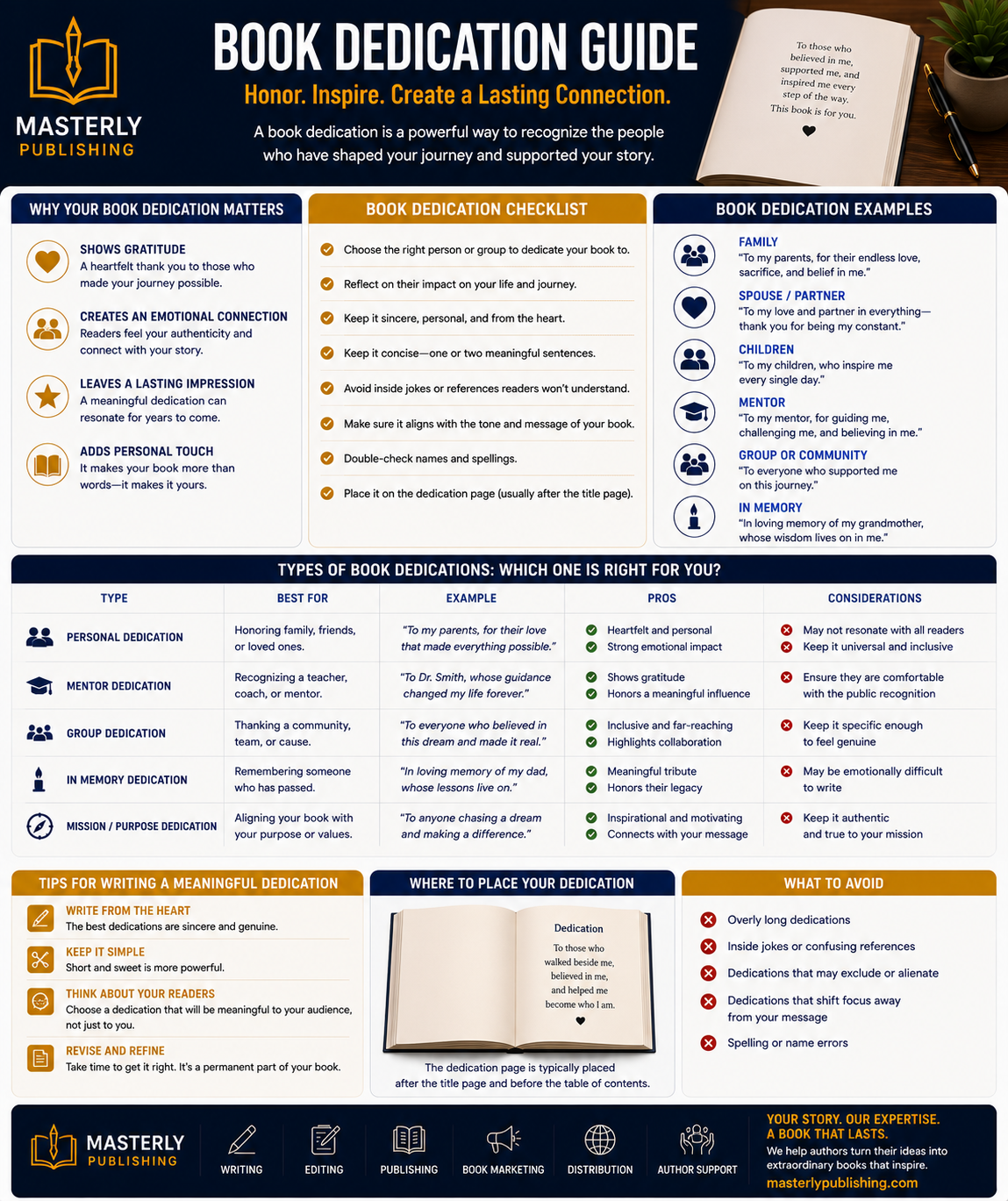
A Book Dedication Can Give Readers a Personal Glimpse Behind the Story
Authors reviewing book dedication examples may see everything from a simple mention of family to lines about students, mentors, friendship, music, art, or the people who inspired a lifelong dream of writing. The perfect dedication is not determined by copying the style of The Great Gatsby, classic fairy tales, or the dedication from an author's first book or later five books. It should fit the writer and the work.
An author might recognize someone who taught an important lesson, brought joy to the creative process, encouraged a love of literature and storytelling, or gave the gift of believing in the project before its success was known. For a novel about a haunted house, for example, the dedication does not need to mention the house, a dark room, or the magic of the tale simply to match the story.
Instead, it can honor all those who helped the author walk through the writing process, imagine what the book could become, and realize that the finished work might someday reach the next generation. Whether the dedication takes a full page, half a page, or only a few words, authors should not forget that the rest of the publishing presentation matters too. Masterly Publishing can help authors bring these supporting elements together as part of a professionally prepared book rather than treating each page or post as an unrelated decision.
Frequently Asked Questions About a Book Blurb and Dedication Examples
What is a book blurb?
A book blurb is reader-facing copy that introduces a book and communicates its central premise or promise without attempting to reproduce the entire work. A book dedication is a brief personal tribute placed near the beginning of a book for a person who mattered to the writer. The dedication page is usually just one line, with a concise dedication often taking a single sentence or short phrase. Many authors dedicate it with simple openings like “For” or “To” to honor family, friends, parents, a mother, father, mom, dad, wife, husband, children, a mentor, or a best friend with gratitude, hope, inspiration, or in memory of someone important in their life. The wording can be a formal dedication or a simple dedication, but it works best when the writing is brief, personal, and specific.
Is a book blurb the same as a book description?
The terms can overlap in common publishing use. A book description may refer more broadly to promotional copy used to describe a book in places such as retailer listings or websites. By contrast, a dedication page is personal front-matter, where the dedication briefly honors someone or something important to the author rather than selling the book. Even a short dedication can set the emotional tone, enhance the reader's connection to the book, and reveal a small glimpse of the author's personal life.
What is back cover copy?
Back cover copy is the promotional text placed on the back cover of a physical book. Its content and length should fit the book and available design space.
What is the book synopsis difference compared with a blurb or dedication to family members?
The key book synopsis difference is purpose. A synopsis typically provides a fuller summary for a professional publishing context, while a blurb is promotional copy intended to interest prospective readers.
Should a fiction book blurb reveal the ending?
A reader-facing fiction blurb generally focuses on the premise, conflict, and stakes rather than revealing major resolutions that are intended to be discovered through reading.
What should a nonfiction book blurb communicate?
A nonfiction blurb should clearly represent the subject, intended reader, and central value or promise of the book without making unsupported claims.
Is a sales description different from a synopsis?
Yes. A sales description is intended to present the book to prospective readers, while a synopsis generally serves a different and more comprehensive publishing purpose.
Can the same book description be used everywhere?
Sometimes, but different placements can have different needs. Variations should remain consistent with the book's overall positioning.
Should book marketing copy match the author's voice?
Book marketing copy should generally feel consistent with the book's subject, audience, genre, tone, and professional positioning.
Can Masterly Publishing help with my book blurb?
Masterly Publishing provides professional editorial and publishing support. Authors can discuss their manuscript, book positioning, description, and broader publishing needs with the team. The team can also help an author client refine personal front-matter such as a dedication when the wording needs to feel true to the relationship being honored. Choosing the right words for a dedication often requires sincerity and brevity, and reading it aloud can be helpful when checking tone and flow.
Request Editorial and Publishing Support From Masterly Publishing
Your book blurb should not give readers the entire story, but it should give them enough of the right story to understand why the book deserves their attention.
Masterly Publishing can help align your book description, back cover copy, sales description, and other appropriate book marketing copy with the manuscript and professional publishing presentation.
Bring the book and the materials surrounding it together before publication.
Call:
(888) 209-4055
Website:
masterlypublishing.com