

Book Copyright Page: What Authors Should Understand Before Final Layout
The copyright page is one of the last things readers notice and one of the first things distributors, libraries, and retailers check. Getting it right before your files go to print or ebook conversion prevents downstream problems with cataloging, sales channels, and rights disputes.
Quick answer: what your book copyright page must do
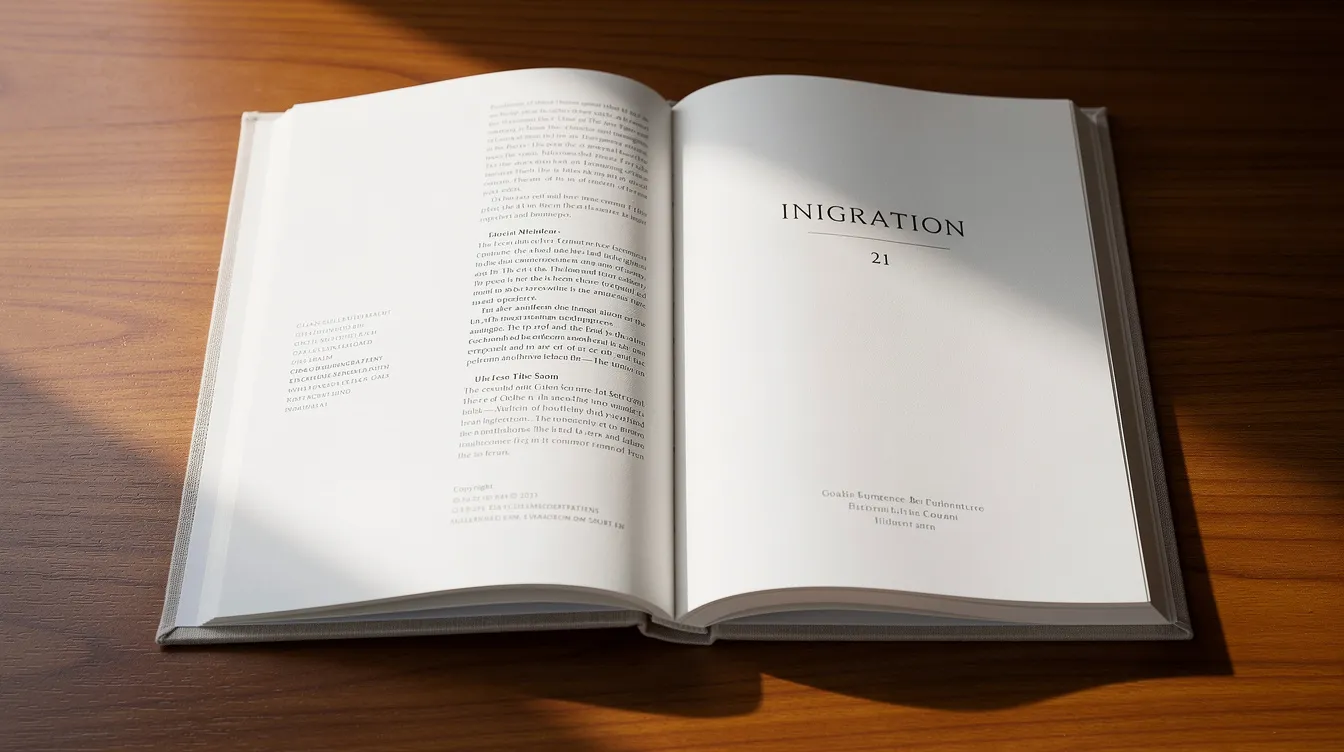
A copyright page usually appears after the title page, printed on the verso (left-hand page) in a published book. It is part of the book front matter and serves a single core purpose: it declares ownership of the work by identifying the copyright owner, the year of first publication, and a basic rights notice. Whether you publish under your legal name or a pen name, these facts anchor the page.
A copyright page provides essential publishing information for retailers, libraries, and distributors. It helps prevent copyright infringement by putting the world on notice that the content is protected. Copyright pages also help prevent book piracy and plagiarism by documenting who holds the rights and when the work was first published.
Although many elements on the page are optional, a complete copyright page signals professional production. Masterly Publishing helps authors assemble and format every copyright page element, but we do not replace jurisdiction-specific legal advice. Complex rights questions should be reviewed with an attorney-guided service before final layout.
Core elements every copyright page should usually include
Most commercial books printed between 2024 and 2026 carry a consistent set of minimum elements on the copyright page. A copyright page typically includes a copyright notice, and the following items round out the standard block:
- Copyright notice: The copyright symbol, year, and copyright owner's name (e.g., © 2026 Jane Rivera)
- Rights reserved notice: A short statement such as "All rights reserved." Common copyright page elements include rights reserved statements like this one.
- Edition information: Labels such as "First Edition" or "Revised Edition" when applicable. It includes the copyright notice and rights reserved statement together.
- Publisher or imprint line: The publisher name, city, and contact details
- ISBN(s): One isbn number per format (hardcover, paperback, ebook)
Present these as compact text blocks, typically in a font 1–2 points smaller than body text. Later sections below cover optional components like disclaimers, Library of Congress data, and ordering information.
Copyright notice and rights statement
The copyright notice is the single most recognized element on any copyright page. Under america copyright law, copyright notices are not legally required in the U.S. since the country joined the Berne Convention in 1989. Including one, however, eliminates the "innocent infringement" defense that someone who copies your work might otherwise raise.
A copyright notice includes the copyright symbol (©), the year of first publication, and the owner name. If the copyright holder is an individual, the line reads like this:
© 2026 Jane Rivera. All rights reserved.
If you write under a pen name, the notice can list that name. For example: "© 2026 J. Reyes (a pen name of Jane Rivera)." Alternatively, the legal name can be omitted from the published book entirely and disclosed only in copyright office registration records. Under copyright law, pseudonymous works receive a term of 95 years from publication or 120 years from creation, while works attributed to a named author last the author's life plus 70 years.
The rights reserved notice can be a concise "All rights reserved." or a longer statement specifying that no portion thereof may not be reproduced in any form whatsoever, stored in a retrieval system, or transmitted by any mechanical methods without prior written permission or express written permission of the copyright owner. Most indie authors find the concise version is perfectly fine.
The copyright page does not create copyright. It documents and signals existing rights at the time of publication. Fair use provisions still apply regardless of the notice language.
Edition information, ISBNs, and publishing imprint details
This section of the copyright page records which version of the book the reader is holding and how to find it in commercial systems.
Edition information indicates if the book is a first or subsequent edition. Common formats include "First Edition: April 2026" or "Second Edition, Revised: October 2027." Reprints without content changes do not count as new editions. Reserve the label for versions with substantive revisions.
ISBNs (International Standard Book Number) are the backbone of book commerce. An ISBN is a unique identifier for your book; each format typically needs a separate ISBN. An ISBN is necessary for print books and some ebooks. Since 2007, all new ISBNs use a 13-digit structure divided into five parts: book prefix (978 or 979), registration group, registrant, publication identifier, and check digit. Most print editions require an ISBN for distribution, and ISBNs are essential for selling books in physical stores. ISBNs help bookstores and libraries catalog your book, and including an ISBN on the copyright page aids book identification across every sales channel.
Group them with format labels:
ISBN 978-1-234567-89-0 (paperback) ISBN 978-1-234567-90-6 (ebook)
Publishing imprint is the trade name under which the book is published. It appears as a simple line like "Published by [Imprint Name], [City, State/Country]." Publisher information includes the name, location, and contact details of the publisher or imprint. If you run your own publishing company, the publishing imprint line carries your company name and the publisher's address. Masterly Publishing can help authors decide how to list their publishing company, imprint, and author website without overloading the page with publishing information.
Library of Congress numbers and CIP data block
These elements matter mainly for authors targeting libraries and institutional buyers. Library of Congress information provides bibliographic and classification information for libraries, helping librarians shelve and discover the book.
A Library of Congress Control Number (also called a congress control number, or LCCN) is assigned through the Library of Congress Preassigned Control Number (PCN) program. U.S. publishers apply before publication and print the number on the copyright page.
The cip data block is a separate element: a compact paragraph of cataloging details (subject headings, classification codes, author information) prepared by the Library of Congress before publication. The CIP data block is printed verbatim on the copyright page, usually in a smaller font, aligned left, and set apart from other elements. The Library of Congress typically issues CIP data to qualifying publishers; large publishers and houses focused on traditional publishing routinely receive it. Self-published authors often use a paid P-CIP (Publisher's Cataloging-in-Publication) service if they are marketing to libraries.
A traditionally published book almost always carries an LCCN or CIP block. These cataloging tools are not required to sell through most online retailers, but they open doors to institutional sales channels.
Disclaimers, permissions, and credits
Three categories of protective and attributive language often appear on the copyright page. Each serves a distinct function.
Disclaimers clarify limitations on the use of the book's content and protect the author from liability.
- Fiction: "This is a work of the author's imagination. Any resemblance to actual persons, living or dead, or actual events is purely coincidental." A disclaimer can clarify that characters are fictional.
- Nonfiction (health, finance, legal): Disclaimers are common in genres like health and finance, specifying that content is for informational purposes only and does not constitute professional advice. Works covering sensitive material should include appropriate warnings.
- Creative nonfiction and memoir: Language noting that names or identifying details have been changed to protect privacy.
Disclaimers help protect authors from potential liability, but legal disclaimers do not eliminate all legal risks. They reduce risk and clarify intent; they do not replace legal counsel.
Permissions notices are required for copyrighted material used in the book. If you quote song lyrics, include epigraphs, or reproduce images not in the public domain, you need written permission and a compact acknowledgment. A permissions notice might read: "Excerpt from [Title] used with permission of the publisher. All rights reserved." For brief quotations embodied in critical reviews or scholarly analysis, fair use may apply, but verify before omitting a permissions notice. Route permission requests through the rights holder's permissions coordinator. No parts thereof may be reproduced in any manner whatsoever without the permission of the publisher or copyright holder for longer excerpts.
Credits acknowledge individuals who contributed to the book's production: cover design, interior layout, illustrations, photography, editing. These lines can appear on the copyright page or in a separate acknowledgments section. Verify whether referenced content is truly in the public domain before omitting permissions language.
Optional but useful details on modern copyright pages
Beyond the required core, several optional elements serve specific distribution and branding goals:
- Ordering information: A concise line with an email, website, or mailing address for bulk sales to schools, bookstores, and organizations. Keep it to one or two lines so it reads as a resource, not an advertisement.
- Printer's key: A number line such as "10 9 8 7 6 5 4 3 2 1" that tracks printing numbers within an edition. The first printing shows the full sequence; each subsequent run removes the lowest number. Offset print runs and collectible editions still rely on this convention. Print-on-demand books often skip it because each copy is produced individually.
- Printing location: A line like "Printed in the United States of America."
- Environmental notices: Recycled paper statements or FSC certifications, increasingly included for transparency.
Group these optional items at the bottom of the copyright page so they stay compact and readable.

Trademarks, author website, and brand information
The copyright page can clarify how brand names, series titles, and logos are protected. A trademark notice acknowledges registered (®) or unregistered (™) trademarks connected to the book title, series name, or publishing imprint. The notice itself does not create trademark rights; it signals existing claims.
Example phrasing: "[Series Name]™ is a trademark of [Owner Name]. All rights reserved."
Including an author website on the copyright page helps with reader discovery of future books, speaking work, or newsletters. In print, keep the URL short and legible. In ebook editions, make it a clickable link. A well-placed URL strengthens the connection between the creative work and the author's broader brand, improving the reading experience by giving readers a clear next step. It can also complement a book description on retail platforms by pointing to additional context.
Masterly Publishing can help integrate imprint branding, author website, and trademark notices so they look cohesive across print and ebook copyright pages.
Formatting the copyright page for print and ebook editions
In print, the copyright page normally appears on the verso of the title page. Text is usually aligned left or centered near the bottom half of the page, in a type size 1–2 points smaller than body text. Avoid decorative fonts; legal and cataloging information needs to stay legible.
For the publishing industry at large, whether a book is independently published, produced by a self publisher, or released through a traditional house, the placement and formatting conventions are the same. Self published books and self published authors working in self publishing follow the same layout standards that any publishing company would.
Ebook editions introduce a wrinkle: e-readers sometimes skip front matter and land the reader at Chapter 1. Setting the correct start location in the epub file ensures the copyright page remains accessible without disrupting the reading experience. Test the file on multiple devices before finalizing.
Masterly Publishing's production team applies consistent formatting across paperback, hardcover, and epub so the copyright page reads correctly everywhere.
Using copyright page templates and getting help before final layout
Most authors adapt existing copyright page templates rather than building from scratch. Self-published authors often use simpler copyright page templates tailored to their genre and distribution goals.
Three common template structures at a high level:
- Basic fiction: Copyright notice, rights reserved notice, publisher line, ISBN, fiction disclaimer, cover credit, printer's key
- Nonfiction with disclaimer: Copyright notice, rights reserved notice, publisher line, ISBN, subject-specific disclaimer, permissions notices, cip data block, ordering information
- Low-content or journal: Copyright notice, rights reserved notice, publisher line, ISBN
A free copyright template works as a checklist: copyright notice, edition information, ISBN, cip data block when applicable, ordering information, author website, and own information about the publisher. You simply fill in each field with your own details. A copyright template should be customized to the author's jurisdiction, publishing goals, and distribution partners. Any item carrying legal weight should be reviewed with an attorney-guided service before the book goes to print. Register your work with the copyright office for additional protection.
Whether your book is a first published title, a book review copy, or the latest in a series of new editions, the copyright page sets the professional foundation for every piece of writing you release.
Ready to finalize your copyright page? Masterly Publishing helps authors assemble print-ready and ebook-ready files, including a professional copyright page that meets distributor and library standards. For complex legal questions, we route you to our attorney-guided service.
Contact Masterly Publishing at (888) 209-4055 or visit masterlypublishing.com to get started.