

Book Proposal Services: Building a Market Case Before Writing the Full Manuscript
A nonfiction book proposal is not a rough draft. It is a business case for a book idea, typically ranging from 10 to 25 pages plus sample chapters, designed to secure a literary agent, a traditional publisher, or an internal greenlight before writing the full manuscript. Professional book proposal services assist authors in structuring, writing, and refining this document so it speaks the language decision-makers already use.
This page is for experts, executives, and subject-matter leaders who want to publish with credibility. Whether you are a healthcare CEO preparing a proposal for a Spring 2027 list or a fintech founder positioning an AI ethics book for Q1 2028, the goal is the same: prove your book concept, audience, market potential, and your ability to help sell it. A book proposal can take weeks or longer to prepare, and rushing the process almost always shows. Even if you ultimately self-publish, this work clarifies audience, structure, and book market positioning for every production and marketing decision that follows.
Strong proposals start with understanding what agents and publishers actually look for.
What Agents and Publishers Expect From a Nonfiction Book Proposal
Major New York publishers, established independent presses, and most literary agents use nonfiction book proposals to decide which projects to acquire each season. Spring 2027 lists, for instance, may close for acquisition decisions by mid-2026, meaning the proposal needs to be circulating well before that window.
Authors need a clear proposal structure to attract literary agents and traditional publishers. In prose terms, agents and acquisitions editors expect a clear hook or central promise, a defined target audience, a competitive title or comparable titles section, a proposal chapter outline, polished sample chapters, a marketing and publicity plan, an author platform section, and a concise author bio.
For prescriptive and idea-driven books in categories like business, self help, parenting, and health, the commercial case often outweighs stylistic flair. Agents want evidence of market size, urgency, and author credibility. By contrast, narrative nonfiction and memoir lean more heavily on writing quality and sample chapters, though platform and media potential still factor into every acquisition meeting. A strong proposal improves chances of securing a traditional book deal because it reduces perceived risk for everyone involved. Even if an author already holds a complete manuscript, a clean, industry-standard proposal is usually required before any agent or editor will review the project.
Knowing these expectations up front allows book proposal services to reverse-engineer a document that feels familiar and low-risk to agents and publishers.
Core Components of a Strong Nonfiction Book Proposal
Most successful books start with proposals built from the following sections, or close variants. Proposal structure includes a high-level overview, an annotated table of contents, and a comprehensive marketing plan, among other elements. Our services help authors build and sequence each part strategically.
Here is what each component does:
- Overview: A 2–3 page executive summary that sells the idea, the need, and the author. Think of it as the introduction to your entire business case.
- Target audience: A specific portrait of who buys, reads, and recommends the book, with quantifiable detail rather than vague demographics.
- Competitive title analysis: Five to ten comparable titles showing where the book fits and how it differs from other books already on the shelf.
- Author platform and marketing plan: Evidence that the author can reach and mobilize readers, paired with concrete promotional commitments.
- Author bio: Credibility, expertise, and traditional media readiness aligned with the topic.
- Proposal chapter outline and detailed table of contents: A chapter-by-chapter map of the book's argument or story arc.
- Sample chapters: Usually one to three chapters that prove voice, structure, and value.
Delivery of services varies from full proposal creation to coaching and editing. Editorial feedback helps improve clarity, organization, voice, tone, and strength of the pitch. Book proposal editing and coaching services are available for authors who prefer to draft independently and then refine with professional guidance. We also customize proposals for alternate approval paths, such as internal corporate presses, university-affiliated imprints, and bulk-buyer partners.

Competitive Title Analysis: Positioning Your Book in a Crowded Market
The competitive title or comparable titles section is where many nonfiction writers struggle, but it is often the first place acquisitions editors scan to see if a book belongs on their list. Proposal services assist authors in identifying comparable titles to demonstrate audience potential and market viability.
Our approach starts by selecting five to ten recent competitive titles from traditional publishers, ideally published in the last five years for relevance. We focus on books your ideal reader actually buys rather than obscure or self-published comp titles. For each title, we examine the book's promise, table of contents, author platform, and reader response to clarify how your book is similar enough to prove demand yet different enough to earn shelf space.
We help authors summarize each competitive title in 100 to 200 words, crafting short, commercially focused paragraphs that describe what reader need it meets, how well it appears to have sold, and how your book updates, extends, or repositions the topic. A competitive titles section should include five to ten titles. Avoid claiming there are no competitive titles for your book. That signals inexperience rather than originality. We also consider comp titles in adjacent categories when your book crosses boundaries, because agents expect a realistic view of overlap and opportunity.
The deliverable is a polished competitive titles section plus strategic notes that feed the overview, hook, and marketing angles in the rest of the proposal.
Developing the Proposal Chapter Outline and Table of Contents
A clear chapter outline or table of contents shows agents and publishers how the idea unfolds logically across the book, helping them imagine editorial fit and production scope. Market analysis establishes a book's unique selling proposition and target audience demographics, and the chapter outline is where that analysis becomes structural.
Our book proposal services include structured planning sessions where we map the reader journey from chapter one through the final chapter, ensuring each chapter answers a specific question or solves a concrete problem. We help authors choose between a concise table of contents and a more detailed proposal chapter outline depending on category. A prescriptive business book might need a paragraph or two per chapter describing frameworks and case studies, while a concept-driven title might use shorter sketches.
We stress-test the structure against competitive titles, making sure the book does not simply mirror a well-known best seller published in 2021 or 2022 but instead offers fresh sequencing, depth, or application. The final deliverable is a clean, industry-standard table of contents plus chapter descriptions that serve both the proposal and a practical roadmap when writing the full manuscript. This structural clarity also supports later marketing, as chapters can double as keynote frameworks, workshop modules, or online course units.
Crafting Sample Chapters That Prove You Can Deliver the Book
Agents and editors often skim the overview and comp titles, then turn directly to the sample chapters to test whether the author can actually deliver on the book's promise. Weak samples can kill a proposal even when the concept and competitive analysis are excellent.
For prescriptive nonfiction, we typically recommend one foundational chapter plus a high-impact chapter that showcases tools, case studies, or frameworks. For narrative nonfiction, we usually start at the chronological or emotional beginning of the story. Our team helps authors outline, draft, or revise one to three sample chapters, focusing on clarity, pacing, and concrete takeaways while keeping the author's authentic voice and style intact.
Where appropriate, we align sample chapters with key moments in the chapter outline. A leadership book, for example, might pair its origin story chapter with the chapter that introduces a core four-part model, so decision-makers can see both narrative and practical value. We also coordinate the sample chapters with the marketing plan, ensuring they include quotable lines, frameworks, or stories that can drive media pitches, op-eds, or speaking engagements once the book is under contract.
The goal is not to write the entire manuscript early but to provide just enough proof to reduce risk for agents and publishers evaluating the proposal.

Building the Author Platform and Marketing Plan Section
The author platform section and marketing plan are often the deciding factors in competitive nonfiction categories. A strong author platform is crucial for nonfiction book sales, and you typically need visibility to tens of thousands of people for a publisher to feel confident investing in your project. Your platform should demonstrate your expertise and credibility, not just raw follower counts.
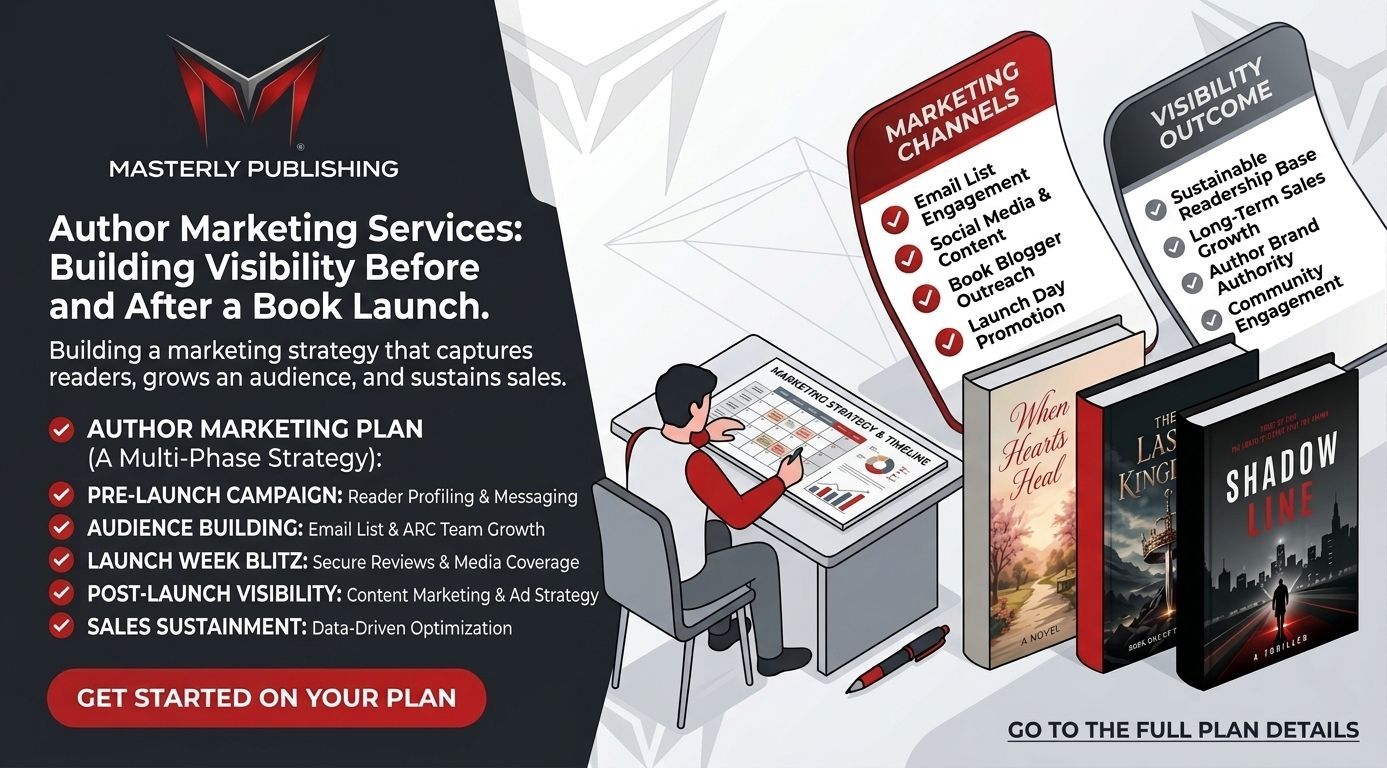
Our book proposal services start by inventorying the author's existing reach: website traffic, newsletter subscribers, LinkedIn and social followings, speaking engagements, podcasts, media appearances, and organizational partnerships. A newsletter can enhance your direct connection to readers in ways that social media algorithms cannot replicate. We translate these assets into concrete, verifiable marketing commitments-"monthly newsletter to 18,000 subscribers," "2026 conference keynote with 3,000 attendees," or "regular column in an industry publication"-rather than vague promises.
Authors need a sizable platform to attract major publishers, and authors without a platform may struggle to sell memoir proposals in particular. A strong marketing plan must include concrete actions and results, not aspirational wish lists. Book proposals often require a marketing plan detailing specific actions the author will take before, during, and after publication.
For authors with a modest platform, we help prioritize the most efficient growth moves to undertake while the proposal is circulating, so that metrics are improving by the time agents and publishers review the project. Proposal services help define the target readership, market positioning, and author credentials so the entire section reads as a practical, low-risk plan for partners.
How Our Book Proposal Services Process Works
Working with Masterly Publishing follows a phased process from early discovery to final deliverables:
- Discovery consultation: Clarifying goals (traditional deal, hybrid press, internal imprint), timeline, and existing material.
- Market and competitive review: Early research into competitive titles, audience, and category conventions.
- Positioning and structure sessions: Refining the book's core hook, promise, and chapter outline.
- Drafting support: Collaborative writing or heavy editing of overview, competitive titles section, author bio, platform, and proposal chapter outline.
- Sample chapter development: Outlining, editing, or coaching on sample chapters.
- Final proposal polish: Line-level refinement for clarity, tone, and coherence before querying agents or presenting to internal stakeholders.
A typical full proposal engagement spans 8 to 12 weeks, depending on author availability. Authors may receive coaching on approaching agents and submission strategy from our team. We do not promise specific advances, bestseller outcomes, or guarantee representation, but we do deliver a submission-ready nonfiction book proposal tailored to the author's strategy. This same process adapts for internal corporate approvals, association publishing programs, or custom imprint projects where a formal proposal is required.
Who Benefits Most From Professional Book Proposal Support
The nonfiction authors who gain the most from book proposal services are senior consultants, founders, physicians, technologists, policy experts, and nonprofit leaders whose time is limited but whose ideas are commercially and socially significant.
Consider a few scenarios: a cybersecurity expert seeking a traditional deal with a major New York publisher who needs a competitive title analysis and market-ready proposal by late 2026. A chief marketing officer planning a 2027 book to support a speaking and advisory business, using the proposal to secure both a publisher and high-value brand partnerships. An academic or think-tank researcher translating complex findings into a mainstream nonfiction book based on years of fieldwork, requiring help with structure, audience definition, and comp titles beyond scholarly presses.
First-time and experienced writers both benefit. Newcomers need guidance through unfamiliar expectations. Veterans need updated positioning in a publishing industry that has changed significantly since their last publication. Even if an author ultimately chooses hybrid or self-publishing, the same proposal work clarifies scope, budget, timeline, and launch strategy, making later production and marketing decisions more efficient. Proposal work is an investment in clarity and leverage, not just a gatekeeping exercise.

Discuss a Professional Book Proposal Plan
If you are an expert, executive, or nonfiction author interested in creating a comprehensive, market-ready book proposal, we invite you to schedule a publishing consultation with Masterly Publishing. We will explore scope, timing, and fit without high-pressure sales language. The best bet for most busy professionals is to start the conversation early, well before seasonal submission deadlines close.
Contact Masterly Publishing Group
Ready to take the next step? Visit masterlypublishing.com or call (888) 209-4055 to discuss a professional book proposal plan tailored to your goals and timeline.
Frequently Asked Questions
Do I need a full manuscript before engaging? No. Most nonfiction proposals are designed to sell a book before it is written. If you have a complete manuscript, we can still help you build the proposal around it, but a finished draft is not required to begin.
How do proposals differ for narrative nonfiction and memoir? Narrative nonfiction and memoir proposals place heavier emphasis on writing quality and sample chapters, often requiring two to three polished chapters rather than one. Platform and media potential still matter, but the writing must speak for itself.
How long is a typical nonfiction book proposal? Book proposals typically range from 10 to 25 pages, not counting sample chapters. With sample chapters included, the total package may reach 30 to 50 pages.
Does Masterly Publishing approach literary agents on my behalf? We prepare submission-ready materials and can coach you on approaching agents, crafting a query letter, and developing a submission strategy. Representation decisions remain between you and the agent.
How does proposal work connect to ghostwriting, editing, or marketing? The proposal is the first step in a larger process. Once a book deal or publishing plan is in place, our team can support ghostwriting, manuscript editing, and book marketing strategy to help you sell books and promote the finished work through the right channels.
In a marketplace producing over four million titles a year, a polished nonfiction book proposal is one of the clearest ways to prove your book belongs on a publisher's list. Book proposal services from Masterly Publishing help you reduce risk, clarify your vision, and present a compelling case to agents and publishers in a busy 2026–2027 publishing season.