

How Trademark Registration Lawyers Evaluate Publishing Names for Risk
Choosing a publishing name is one of the most exciting moments in an author’s journey. It feels like you’re finally stepping into the identity of a real creator—someone with a voice, a brand, and something valuable to share with the world. But what many writers don’t realize is that a name can also become a legal liability if it conflicts with an existing trademark.
At Masterly Publishing Group, we specialize in helping self-published authors and professional writers achieve their dreams. Whether you’re new to the publishing process or an experienced author looking for comprehensive self-publishing services, we’re here to help. Headquartered in Dallas, Texas, with offices in Houston, West Palm Beach, and Grand Prairie, we proudly serve clients worldwide. Our Grand Prairie location features a state-of-the-art content creation studio that empowers authors to create promotional materials, book trailers, and podcasts.
From manuscript to bestseller, Masterly Publishing Group is your partner for publishing, marketing, and navigating legal hurdles. In this article, we’ll explain how trademark registration lawyers evaluate publishing names for risk, how the trademark registration process works, and how smart trademark strategy can protect your work long-term.
Why Publishing Names Create Trademark Risk Faster Than Authors Expect
A publishing name is not just creative—it’s commercial. The moment you use that name in marketing, on a book cover, on a website, or in sales platforms, it becomes part of your business identity. That means your name can be seen as a trademark, even before you file anything.
Authors often assume that because they came up with a name first, they automatically have rights. But trademark law doesn’t work that way in practice. Rights often depend on who used the mark first in commerce, where it was used, and what goods or services are tied to it.
That’s why choosing a name without research can lead to expensive rebranding later. A publishing name that feels “perfect” today can become a legal problem after you’ve already built your audience.
What Trademark Registration Lawyers Actually Look For
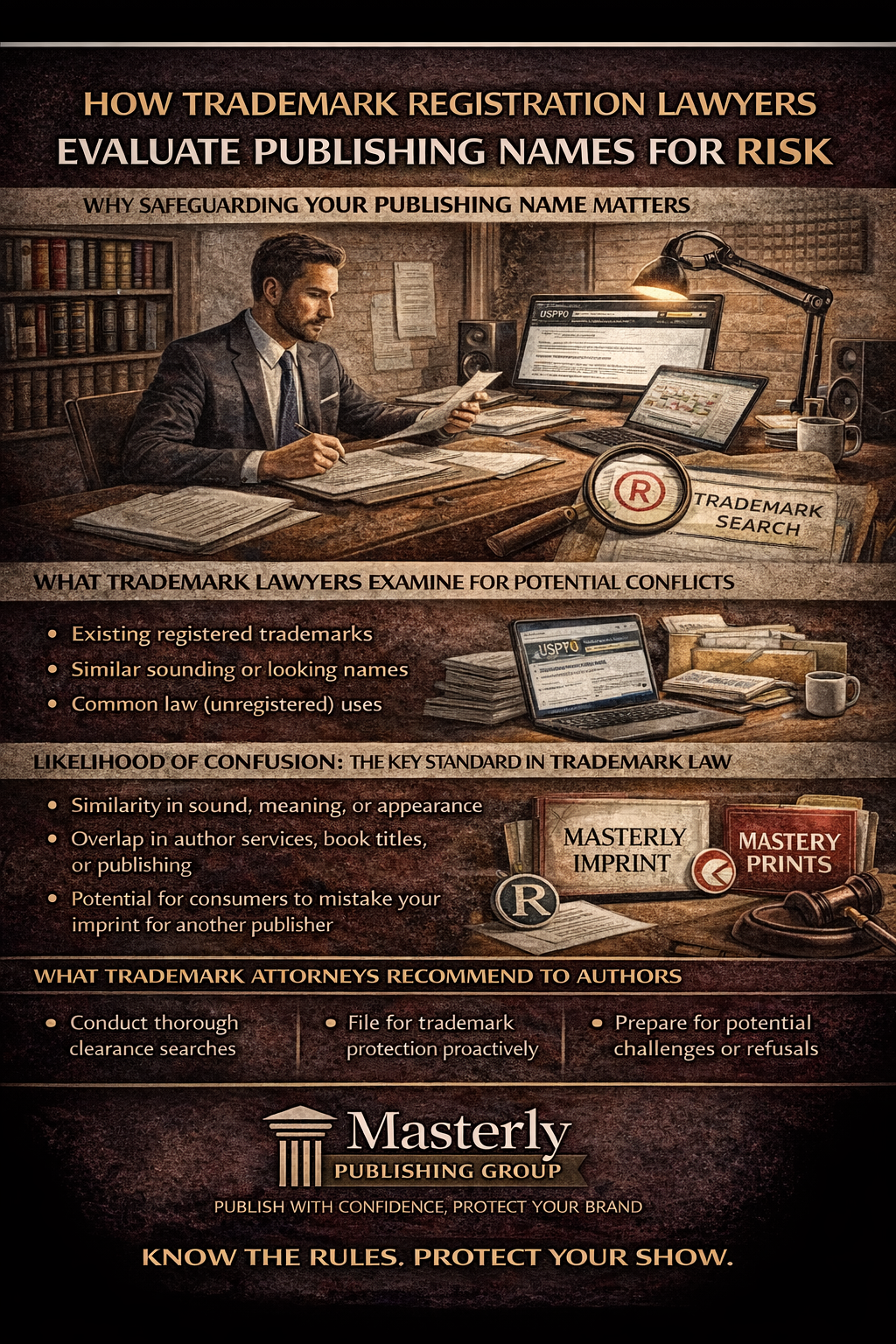
Trademark registration lawyers don’t evaluate names based on personal taste. They evaluate names based on risk, conflict potential, and how likely a trademark office will view it as confusingly similar to other marks.
A lawyer will look at more than spelling. They also evaluate sound, meaning, and overall commercial impression. Even small differences may not matter if consumers would believe the brands come from the same source.
The key issue is whether your name is likely to cause consumer confusion. If your name appears too close to an existing mark, you could face trademark infringement claims or rejection at the patent and trademark office.
Understanding What a Trademark Really Is in Publishing
A trademark is a word, phrase, logo, or design that identifies the source of goods or services. For authors, a trademark may apply to a publishing imprint name, a series name, a book title used like a brand, or a business name used for publishing services.
Your mark becomes your identity in the marketplace. It builds reputation, trust, and recognition across platforms. That’s why trademark protection is so valuable for serious writers who plan to publish multiple books or run a long-term brand.
The stronger your mark, the easier it is to protect and enforce. But the stronger it becomes, the more expensive it is to lose it.
Why “It’s Just a Pen Name” Can Still Be a Legal Issue
Many authors use pen names and assume trademarks don’t apply. But if you build a business around the pen name—selling books, offering services, speaking publicly, or running a website—then the name may function as a trademark.
Even if it started personal, it can turn commercial fast. Your audience associates your pen name with a specific type of content and quality. That creates value—and value attracts legal risk if the name overlaps with someone else’s brand.
This is why trademark counseling matters early. A name is not “just a name” when it becomes a commercial identifier.
Trademark Clearance: The First Step Before You Fall in Love With a Name
Before filing a trademark application, an experienced trademark attorney will often recommend trademark clearance. This process is designed to reduce the risk of filing a name that is likely to be rejected or challenged.
Trademark clearance is about strategy, not just searching Google. A lawyer examines databases and common law uses to determine whether a conflict exists. It’s also about future safety, not just today’s visibility.
This is where smart clients save money. If a name is risky, it’s better to learn early than after you’ve paid for covers, marketing, websites, and ISBNs.
Conduct Trademark Clearance Searches the Right Way
A lawyer may conduct trademark clearance searches using multiple layers of review, not just one quick database query. These searches are designed to see if similar marks already exist in publishing or related industries.
Trademark clearance searches may include both registered and unregistered use. That matters because a mark can be protected even without registration, depending on the circumstances. A strong clearance search reduces the chance of stepping into infringement territory unknowingly.
Many authors skip this step and hope for the best. But hope is not a trademark strategy.
Trademark Clearance Searches and Why “Similar” Is More Dangerous Than “Identical”
One of the most misunderstood parts of trademark law is that you don’t need an exact match to have a conflict. Similar marks can be enough to trigger a refusal or a legal dispute.
A trademark office may reject your mark if it believes consumers could confuse it with another brand. The patent and trademark office focuses heavily on likelihood of confusion, not the “creative intent” behind your name.
This is where trademark attorneys offer real value. They know how examiners evaluate similarity and what risk levels are acceptable.
How a Trademark Office Reviews Publishing Names
A trademark office reviews your application based on your mark, your filing basis, and the category of goods or services you list. The office wants to know what you are trying to protect and how that protection affects other trademark owners.
The office does not just protect names in isolation. It protects names as identifiers for specific industries. That means two similar names might coexist in different spaces, but not always.
Publishing is a crowded space, which increases risk. That’s why due diligence is essential when naming your brand.
The Patent and Trademark Office and the USPTO: What Authors Should Know
In the United States, trademarks are typically registered through the United States Patent and Trademark Office, often referred to as the USPTO. You may see the words patent and trademark office, states patent and trademark, or even “united states patent” in common descriptions of the system.
The USPTO reviews trademark applications and determines whether a mark qualifies for registration. The USPTO does not guarantee that no one will ever challenge your mark. But federal registration provides stronger legal protection and clearer enforcement options.
For authors building a publishing business, federal registration can become a key asset. It’s part of protecting intellectual property long-term.
Trademark Registration Process: What Happens After You File
The trademark registration process involves multiple stages, and it rarely happens overnight. Once you submit your trademark filing, your application enters a review queue. A USPTO examiner reviews it for legal and technical issues.
If the examiner sees a problem, they may issue an office action. That office action can request clarification, refuse registration, or require changes. Many authors assume a refusal means the name is dead, but that’s not always true.
With proper legal services and strategy, some refusals can be addressed. The key is responding correctly and on time.
What an Office Action Means and Why It Matters
An office action is a formal letter from the USPTO outlining the problems with your application. It may mention confusion with another mark, description problems, category errors, or technical defects.
This is where many authors get overwhelmed. The language is legal and the timeline is strict. A missed deadline can result in losing the filing and paying additional fees to start again.
Working with a lawyer can reduce the risk of mistakes. Trademark attorneys understand how to respond with proper legal arguments and supporting evidence.
How Lawyers Evaluate “Likelihood of Confusion” in Publishing
When evaluating a publishing name, trademark registration lawyers ask whether an average consumer would think your brand comes from the same source as another. This is one of the most important standards in trademark law.
Confusion can happen in many ways. It can be visual, phonetic, or conceptual. Even different spellings can create confusion if the names sound alike.
That’s why “close enough” is a problem. In trademarks, close enough is often too close.
The Role of the International Trademark Association in Brand Education
The International Trademark Association is widely known for helping educate the public about trademarks, brand protection, and intellectual property matters. While it doesn’t approve your mark, it reflects how seriously trademarks are treated in modern business.
Authors who want to build a global presence should understand that trademarks are not just for corporations. They are for creators who want to own their name, protect their brand, and grow with confidence.
Trademarks are business assets. Publishing is a business. That connection is critical.
Trademark Applications and the Power of Proper Filing Strategy
Trademark applications are not one-size-fits-all. Your filing basis matters, and your category descriptions matter. A trademark attorney will look at how you are using the mark and how you plan to use it.
Some authors file too broadly and create unnecessary risk. Others file too narrowly and leave gaps in protection. The right approach depends on your publishing goals and business model.
This is where trademark strategy becomes personal. Your mark should match your growth plan, not just your first book.
Brand Names vs. Business Name: Why It’s Not Always the Same
Authors often assume their business name and brand name are identical. But in the legal world, they can be different things. Your business name might be the LLC name, while your trademark might be the imprint used on the books.
A trademark is about what the public sees and associates with your work. That’s why branding decisions should be made with legal protection in mind. Changing your imprint name later can confuse readers and weaken your long-term value.
A well-chosen mark becomes part of your identity. It helps protect your reputation.
Trademark Infringement Risks: What Happens If You Choose the Wrong Name
If your publishing name conflicts with another mark, you could face trademark infringement issues. That could include cease-and-desist letters, demands to stop using your name, or even litigation.
Trademark infringement disputes can be expensive and stressful. Even when you believe you did nothing wrong, you may still need to defend your position. This can disrupt marketing, delay release dates, and damage momentum.
The best way to avoid this is early clearance and smart filing. Prevention is always cheaper than defense.
The Real Costs of Rebranding After You Launch
Rebranding is not just a new logo. It impacts every piece of content you built under the name. That includes covers, websites, ISBN records, author pages, podcasts, trailers, and marketing materials.
It also impacts search and discoverability. Your audience might not find you easily when your name changes. That can hurt sales and create long-term confusion.
The pain of rebranding is why trademark clearance matters early. When you protect your name, you protect your future.
Trademark Protection and Exclusive Rights: Why Registration Matters
Trademark registration can provide exclusive rights that strengthen your position in the marketplace. It can help you prevent others from using similar names in your category, and it can create stronger enforcement options.
Trademark protection is also valuable for licensing and commercial transactions. If you ever want to sell your brand, expand internationally, or build partnerships, a registered trademark can increase value.
For authors, this is about more than law. It’s about owning your brand as you grow.
Trademark Portfolios: Thinking Beyond One Book
Some authors publish one title and stop. Others build an entire world of books, series, and branded programs. For growth-minded creators, trademark portfolios become relevant.
A portfolio can include your imprint, your series name, your publishing company name, and other marks tied to your brand. This creates stronger brand protection as your business expands.
Trademark portfolios also help businesses protect long-term value. Your name becomes more powerful when it’s built on protected identity.
Opposition and Cancellation Proceedings: Challenges Brought by Others
Even after filing, your trademark can face challenges brought by others. This may happen during the publication stage, when others have the chance to oppose your registration.
Opposition and cancellation proceedings are formal ways to challenge a mark. These disputes can be stressful because they may slow down your registration. They can also turn into serious legal fights if not handled properly.
A strong strategy reduces the chance of opposition. But if it happens, you need support.
The Trademark Trial and Appeal Board and Why It Matters
The Trademark Trial and Appeal Board plays a major role in trademark disputes. You may also hear it referred to as the trial and appeal board or described in phrases like trademark trial and appeal.
This is where certain disputes involving refusals, opposition, and cancellation are handled. It’s part of the USPTO system, but it operates like a legal forum. Evidence, arguments, and procedure matter.
When clients face these disputes, they often need legal services from attorneys who understand trademark litigation and appeals.
USPTO’s Trademark Trial System and What It Means for Authors
You may see references to the USPTO’s trademark trial process when discussing disputes. The trademark trial system is not casual. It follows rules that require deadlines, legal filings, and persuasive arguments.
For authors and small publishing brands, this can feel overwhelming. That’s why an experienced trademark attorney can be a major advantage.
Even if you’re not expecting litigation, your mark should be built to withstand it. Smart filing is defensive protection.
Trademark Enforcement: Protecting Your Name After Registration
Registering is not the end of the journey. Trademark enforcement matters because a registered mark must still be protected. If others start using a confusingly similar name, you may need to act.
Trademark enforcement can involve monitoring, warning letters, or enforcement actions when necessary. Some cases lead to litigation, while others resolve early. The goal is to stop confusion and protect your brand identity.
A mark is only valuable if you can enforce it. That’s why protection and strategy work together.
When Trademark Disputes Lead to Federal Court
Some disputes go beyond administrative review and become lawsuits in federal court. This is more common when businesses believe serious infringement is occurring or damages are involved.
Federal court litigation can be expensive and time-consuming. It may involve discovery, legal motions, and long timelines. Authors who face federal court issues often wish they had done more clearance early.
This is another reason trademark counseling is worth it. It reduces risk and helps you make smarter choices from the beginning.
Why Many “Best Lawyers” Conversations Miss the Real Point
Authors often search for “best lawyers” or top rated attorneys without knowing what specialty they truly need. Trademark issues are not general legal problems. Trademark practice requires specific understanding of the USPTO, filing rules, and enforcement strategy.
The right lawyer isn’t just someone with a strong reputation. It’s someone who knows how to evaluate publishing names, guide trademark applications, and build a long-term plan for protection.
Great counsel is part of building a great publishing business. Your brand deserves that.
How Masterly Publishing Group Helps Authors Build Safe, Powerful Brands
At Masterly Publishing Group, we do more than publish books—we help authors build careers. We support writers from manuscript to marketing and help them avoid legal pitfalls that can derail progress.
Our services include publishing support, marketing assistance, and guidance through legal hurdles that many creators never expect. Our clients come from around the world, and we’re proud to serve both new and seasoned authors.
We also empower authors with content creation opportunities, including promotional materials and podcast production. That’s how we help bring stories to life.
When to Talk to an Experienced Trademark Attorney Before You Publish
You don’t need to panic every time you name a project. But you should get help before you invest heavily in a brand name that could be risky. That includes imprint names, publishing labels, and long-term author brands.
It’s especially important if you plan to:
- Build a long-term publishing business
- Create a brand with multiple titles
- Sell internationally or expand into merchandise
- Partner with other businesses or license content
- Invest in professional marketing and studio promotion
These are growth moves. Growth deserves legal protection.
Contact Masterly Publishing Group for a Free Consultation
If you’re building your author brand and want to protect your publishing name before problems arise, we’re here to help. Choosing the right name is exciting—but protecting it is what keeps your momentum safe. When you work with Masterly Publishing Group, you get support for publishing, marketing, and navigating intellectual property hurdles with confidence.
If you need guidance from a u.s trademark attorney or want help understanding trademark registration, trademark clearance, and the trademark registration process, our team can connect you with the legal support you need. We assist clients worldwide and can help you avoid expensive mistakes before they happen.
Call (888) 209-4055 for a free consultation today. Let’s talk about your publishing goals, your brand name ideas, and how to protect what you’re building before the market gets crowded.